

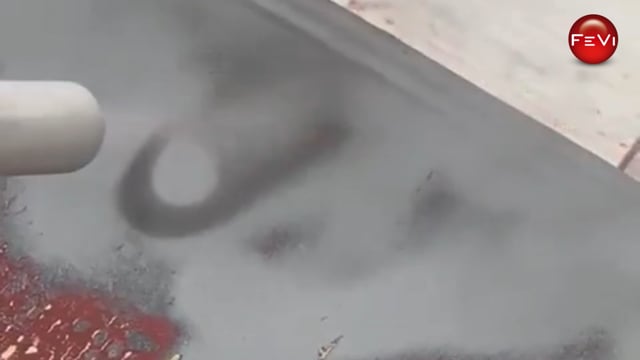
Type of operation
Explanation: Paint stripping on extensive surfaces requires a system capable of removing old paints and coatings evenly, while maintaining adequate productivity across large areas.
The use of scrapers, brushes or mechanical tools can involve long processing times and uneven results. Traditional dry blasting, on the other hand, provides high removal capacity but can generate a considerable amount of airborne dust, particularly when extensive surfaces are treated.
Why it happens: Over time, paints and coatings can deteriorate because of exposure to weather conditions, wear, moisture or the natural loss of adhesion to the substrate.
In other cases, the surface may have several layers applied over the years, making it difficult to apply a new finishing cycle without preliminary removal.
Removal of the existing coating therefore becomes necessary to:
- Eliminate detached or poorly adhering areas;
- Remove overlapping paint layers;
- Expose the underlying substrate;
- Make the surface more uniform;
- Prepare the substrate correctly for a new treatment;
- Promote the adhesion of primers, paints or protective coatings.
When the surface being treated is extensive, the amount of dust that may be generated also increases. Pre-dampening the abrasive at the outlet makes it possible to maintain good removal capacity while substantially reducing particle dispersion in the surrounding area.
The FEVI solution
The Waterblast 120 combines the operation of a pressure blasting machine with an abrasive pre-dampening system positioned close to the nozzle.
During the process, the abrasive is accelerated by compressed air along the blasting hose. A controlled quantity of water is added only in the final section, dampening the particles before they reach the surface.
This operating principle preserves the energy and removal capacity of the abrasive jet while limiting the formation of airborne dust clouds.
The system is particularly useful for paint stripping on extensive surfaces, where traditional dry blasting could cause considerable dust dispersion throughout the surrounding environment.
| Component | FEVI recommended choice | Technical specifications |
|---|---|---|
| Recommended machine | WATERBLAST 120 | Air-assisted wet abrasive pressure blasting machine with abrasive pre-dampening at the outlet. Venturi nozzle diameter 8 mm, length 150 mm. Operating pressure used during the test: 8 bar. |
| Recommended abrasive | OLYBLAST | Ecological abrasive, particle size 0.1–0.5 mm |
The technical value of abrasive pre-dampening
The main characteristic of the Waterblast 120 is not simply the addition of water to the process, but the pre-dampening of the abrasive only at the point where it is about to leave the nozzle.
Compared with completely dry blasting, this makes it possible to suppress a significant proportion of the dust generated by impact.
Compared with systems using large quantities of water, pre-dampening also makes it possible to:
- Use water in a more controlled way;
- Limit the volume of liquid present in the working area;
- Maintain a marked abrasive action;
- Reduce the formation of aerosols and dispersed dust;
- Facilitate the management of work on large surfaces.
Mistakes to avoid
- Describing Waterblast as a simple water-blasting system: Its technical value lies in pre-dampening the abrasive in the final section of the jet. The abrasive is conveyed by compressed air and dampened only close to the outlet.
- Considering the process completely dust-free: Air-assisted wet abrasive blasting substantially reduces airborne dust, but does not completely eliminate particles, residues or removed material.
- Using the same adjustment on every surface: Pressure, abrasive flow, water quantity, distance and travel speed must be adapted to the resistance of the substrate and the thickness of the coating.
- Dwelling too long on the same point: The jet must be moved regularly to avoid uneven removal or excessive etching of the underlying material.
- Using an undersized compressor: The 8 mm Venturi nozzle requires a high airflow. The compressor must be capable of maintaining the operating pressure throughout the process.
- Setting an insufficient quantity of water: Pre-dampening that is too limited can reduce the effectiveness of dust suppression.
- Using an excessive quantity of water: A water supply greater than necessary can unnecessarily increase damp residues and make management of the working area more complex.
- Failing to check the substrate’s compatibility with water: Before the operation, it is necessary to check that the surface and surrounding elements can be exposed to moisture.
- Neglecting residue collection: Water makes the dust heavier, but abrasive, removed material and damp residues remain after the process and must be collected and managed correctly.
- Failing to carry out a preliminary test: Before treating the entire surface, the configuration should be checked on a limited area, assessing removal capacity and the result on the substrate.
Final result
The configuration comprising the Waterblast 120, 8 × 150 mm Venturi nozzle, operating pressure of 8 bar and OLYBLAST 0.1–0.5 mm ecological abrasive makes it possible to combine:
- Removal capacity on extensive surfaces;
- Uniform processing;
- Greater control of the jet;
- Substantial reduction of airborne dust;
- Controlled use of water;
- Reduced abrasive dispersion in the surrounding area.
The final result depends on the nature of the substrate, the number and thickness of the layers being removed, travel speed and adjustment of the operating parameters.
Frequently asked questions
What is the difference between water blasting and air-assisted wet abrasive blasting?
The term water blasting is often used generically to describe various systems that use water and abrasive. With the Waterblast 120 air-assisted wet abrasive blasting process, however, the abrasive is conveyed mainly by compressed air and pre-dampened only in the final section of the jet. This configuration maintains the effectiveness of pressure blasting while substantially reducing airborne dust.
Does the Waterblast 120 completely eliminate dust?
No. Pre-dampening provides a substantial reduction in dust, but it does not make the process completely free from particles and residues. Suitable protective equipment and correct delimitation of the working area are still required.
Choose the ideal solution for your paint-stripping operation
The Waterblast 120 is a professional solution for paint stripping on extensive surfaces, particularly in contexts where good productivity must be maintained while substantially containing the dust generated during treatment.
The FEVI technical office will help you configure the most suitable solution by identifying the blasting machine, nozzle, operating pressure and abrasive required for effective, controlled and professional work.
Request advice or a quote