

Type of operation
Explanation: Metal surfaces may be covered with oxidation, deteriorated paints, primers, protective undercoats or other coatings applied during previous processing cycles.
Before applying new paint, carrying out a repair or adding a protective treatment, it may be necessary to remove the existing layers completely and restore the substrate to a clean and uniform condition.
Manual or mechanical tools may be ineffective on shaped surfaces, near welds, edges, joints and hard-to-reach areas. Although open blasting provides high removal capacity, it can also produce considerable dispersion of abrasive and dust throughout the working area.
Recovery blasting makes it possible to work directly on the area being treated, collecting a large proportion of the abrasive and residues through the working head connected to the extraction system.
Why it happens: Oxidation and surface deterioration can form when metal is exposed to moisture, weather conditions, chemicals or demanding operating environments.
Protective coatings and paints can also progressively lose adhesion, crack, lift or become incompatible with the new finishing cycle.
Surface preparation therefore becomes essential to:
- Remove layers that are no longer properly bonded;
- Remove oxidation and contamination;
- Make the substrate more uniform;
- Promote the adhesion of subsequent treatments;
- Prevent existing defects from compromising the new finish.
The FEVI solution
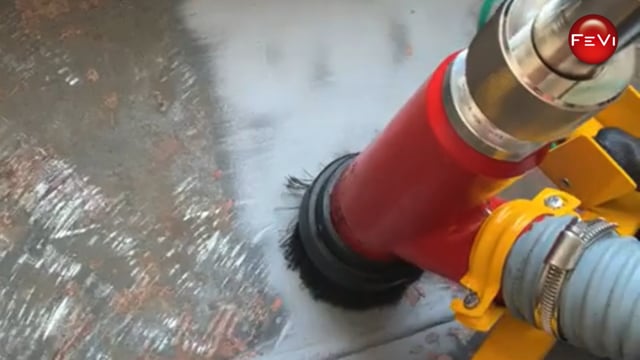
For this application, the Pressure TOP was used, a pressure blasting machine with a recovery system designed to treat surfaces without freely dispersing abrasive throughout the surrounding environment.
During processing, the head is kept in contact with the surface. The abrasive strikes the substrate and performs the removal action; at the same time, the extraction flow recovers the blasting media, dust and removed residues.
The configuration used includes:
- Pressure TOP recovery blasting machine;
- G40 brown fused alumina abrasive;
- Operating pressure of 6 bar;
- Optional dual-grip handle.
G40 brown fused alumina has a particle size suitable for providing an incisive action on oxidation, protective coatings and adhering old paint layers. The abrasive must still be selected according to the thickness of the metal, the consistency of the layer being removed and the required final surface profile.
The dual-grip handle allows the operator to support and guide the head with both hands, improving stability during more demanding or prolonged operations.
| Component | FEVI recommended choice | Technical specifications |
|---|---|---|
| Recommended machine | Pressure TOP | Pressure blasting machine with abrasive recovery system and residue extraction |
| Recommended abrasive | Brown fused alumina | Coriblast brown fused alumina consists of crystalline aluminium oxide and is characterised by high toughness and rapid cutting action on a wide range of materials. |
The technical value of recovery blasting
The main feature of the Pressure TOP is its ability to combine the removal capacity of a pressure blasting machine with the immediate recovery of the abrasive and residues produced.
Compared with open blasting, this technology makes it possible to:
- Limit abrasive dispersion in the surrounding area;
- Reduce the spread of dust;
- Recover material that is still suitable for reuse;
- Provide greater containment of the treated area;
- Work on localised areas without necessarily setting up a blasting cabinet;
- Reduce subsequent collection and cleaning operations.
For recovery to be effective, the head must adhere correctly to the substrate. The shape of the brush or contact accessory must therefore be selected according to the geometry of the surface.
Mistakes to avoid
- Using a head that is unsuitable for the geometry of the part: A flat surface, edge, corner or curved section may require different accessories to ensure correct sealing and effective recovery.
- Lifting the head excessively during processing: If the recovery body is not kept correctly against the surface, abrasive and dust can escape into the surrounding area.
- Selecting an abrasive that is too aggressive: G40 brown fused alumina provides an incisive action. Before treating the entire surface, the result should be checked on a limited area, particularly when working on thin sheet metal or delicate components.
- Using an unsuitable pressure: Pressure, particle size, internal jet distance and travel speed must be balanced according to the coating being removed and the resistance of the substrate.
- Dwelling too long on the same point: Even with a recovery blasting machine, regular movement must be maintained to avoid excessive etching or an uneven finish.
- Neglecting extraction efficiency: Saturated filters, obstructed hoses or insufficient extraction airflow can reduce recovery capacity and cause dust and abrasive to escape.
- Considering recovery to be complete under all conditions: Effectiveness depends on head adhesion, substrate geometry, machine adjustment and the condition of the extraction system.
Final result
The metal is clean and prepared for subsequent processing stages, including:
- Primer application;
- Painting;
- Anti-corrosion protection;
- Visual inspection of the substrate;
- Repair or maintenance of the component.
The dual-grip configuration also improves control of the head, particularly when working on extensive or vertical surfaces and in positions requiring greater operating stability.
Frequently asked questions
What is a recovery blasting machine?
It is a blasting machine that combines the abrasive jet with an extraction system. The head is kept in contact with the surface and recovers a large proportion of the abrasive, dust and material removed during the process.
Does recovery blasting completely eliminate dust?
No. The system substantially limits dust dispersion, but its effectiveness depends on correct head adhesion, substrate geometry and the efficiency of the vacuum unit and filters.
Which machine was used in the video?
The operation was carried out using the Pressure TOP recovery blasting machine.
Which abrasive was used?
G40 brown fused alumina was used.
Which pressure was used for the blasting operation?
An operating pressure of 6 bar was used during the demonstration.
What is the dual-grip handle used for?
The optional dual-grip handle allows the operator to support and guide the head with both hands, improving stability and control during the process.
Can the recovered abrasive be reused?
Material that remains intact may be recirculated, while dust and fine residues are separated by the filtration system. The possibility of reuse depends on the type of contaminant removed and the condition of the abrasive.
Can the Pressure TOP be used on curved or angular surfaces?
Yes, provided that a head suitable for the shape of the substrate is selected. Correct adhesion is essential for maintaining effective abrasive recovery.
Is recovery blasting suitable for removing rust?
Yes. With a suitable configuration, it can remove oxidation, rust, paints and protective coatings from many metal surfaces.
Choose the ideal solution for your restoration operation
The choice of a recovery blasting machine must take into account not only the material being removed, but also the geometry of the surface and the conditions of the working area.
The configuration must be defined according to:
- Material and thickness of the substrate;
- Type of oxidation or coating;
- Flat, curved, angular or irregular surface;
- Size of the area being treated;
- Required surface profile;
- Abrasive being used;
- Compressor airflow;
- Need to limit dust and abrasive dispersion;
- Duration and frequency of operations.
If you need to remove oxidation, protective coatings or old paint layers from a metal surface, tell us:
- The type of component or artefact;
- The dimensions of the area;
- The geometry of the surface;
- The material to be removed;
- The approximate thickness of the coating;
- The specifications of the available compressor;
- The required final result.
The FEVI technical office will help you identify the most suitable recovery blasting machine, head, abrasive and operating parameters for effective, controlled treatment with reduced dispersion of dust and abrasive material.