
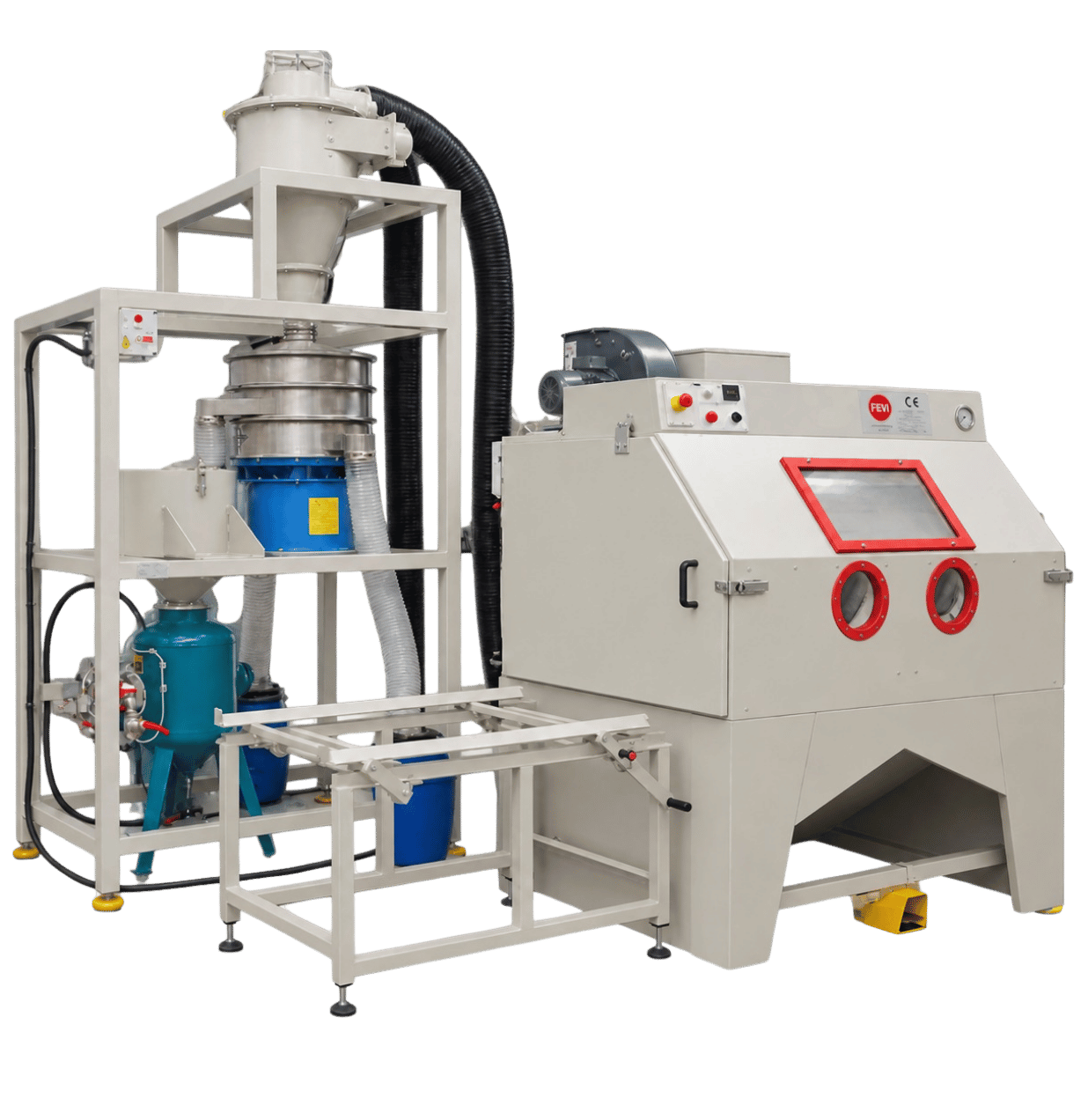
 , Sandblasting machines with cabin


The project requirement
Explanation: Inside a blasting cabinet, the abrasive continuously comes into contact with the component.
During this stage it may collect:
- Residues from the surface;
- Particles of removed material;
- Fragments of paint or coatings;
- Degraded abrasive;
- Particles whose size is no longer suitable;
- Any foreign bodies introduced into the process.
If the abrasive is recovered without correct management, unwanted materials may be recirculated together with particles that are still usable.
The requirement may therefore be to introduce a mechanical selection stage into the recovery circuit, capable of intercepting material that falls outside the specified particle-size range.
The issue is therefore not only:
“How can the abrasive be recovered?”
but:
“Which portion of the recovered abrasive should actually be returned to the process?”
Application analysis
Abrasive selection must be designed according to the material used and the required surface result.
Variables to be considered include:
- Type of abrasive;
- Nominal particle size;
- Permitted particle dimensions;
- Quantity of abrasive circulating in the system;
- Material removed from the component;
- Presence of contaminants;
- Required productivity;
- Surface quality to be maintained;
- Recovery system;
- Extraction system;
- Frequency of abrasive replenishment.
Particle size is an important variable in abrasive blasting and shot blasting processes.
A selection system can help prevent oversized particles, agglomerates or process residues from continuing to circulate with the abrasive intended for projection.
The vibrating screen is therefore incorporated as a functional stage of the circuit rather than simply as a separate accessory.
The solution designed by FEVI
The FEVI configuration integrates the blasting cabinet with a separate structure dedicated to abrasive management, recovery and selection.
The system includes:
- Blasting cabinet;
- Operator station with viewing window;
- Two glove ports;
- Extraction and recirculation system;
- Vertical structure dedicated to abrasive management;
- Screening unit;
- Vibrating screen;
- Collection hoppers;
- Connection pipework;
- Blasting-system pressure vessel;
- Pneumatic circuit;
- External loading structure;
- Machine controls.
The vibrating screen is one of the system's distinctive components.
Abrasive from the recovery circuit can undergo particle-size selection through a vibrating screening surface.
The vibration helps particles compatible with the screen mesh to pass through while separating material of different dimensions.
The result is a circuit in which treatment, recovery and abrasive control are considered parts of the same industrial process.
How the system works
During blasting, the abrasive is projected onto the surface of the component.
After impact, the used abrasive and residues generated by the treatment are conveyed towards the machine's recovery system.
The recovered material can then pass through different separation stages. One of these is the vibrating screen.
The screening surface divides the material according to particle size. The vibrating movement promotes continuous distribution across the mesh and assists particle-size separation.
Abrasive compatible with the parameters defined for the system can continue through the intended circuit, while non-conforming material is separated.
The process logic can therefore be represented as:
Blasting → Collection → Recovery → Separation → Screening → Abrasive selection → Possible recycling into the process.
The actual transfer methods and the different particle-size fractions must be defined according to the specific system configuration.
Why use a vibrating screen?
A simple recovery system allows the used material to be collected.
A vibrating screen adds a further function: mechanically selecting the recovered material according to particle size.
This function can be particularly important when treatment generates residues that may mix with the abrasive.
Screening can help intercept:
- Oversized particles;
- Solid residues;
- Fragments originating from the component;
- Agglomerates;
- Contaminants incompatible with the selected mesh.
This reduces the risk of unsuitable material being reintroduced into the circuit.
Recovery and selection are not the same thing
It is important to distinguish between two functions.
Recovering the abrasive means collecting the material after treatment.
Selecting the abrasive means determining which particles may continue through the system according to the criteria established for the machine.
An industrial system can therefore include different levels of material treatment:
Collection → Dust separation → Screening → Selection → Recirculation.
The final configuration depends on the abrasive used and the contamination generated by the application.
It is this distinction that makes the system particularly interesting for processes in which abrasive control plays an important role.
Particle-size control in the blasting process
Particle size influences the behaviour of the abrasive on the surface.
When material is used repeatedly, part of it can gradually deteriorate while process residues may enter the circuit.
Particle-size control can therefore help maintain a more stable composition of the material used for treatment.
This does not mean that the vibrating screen alone can remove every contaminant.
Fine dust, lightweight particles, metallic contamination or materials with different densities may require additional separation technologies such as pneumatic classification, cyclones or specific separators.
The vibrating screen mainly performs dimensional separation.
Screen mesh size depends on the abrasive
There is no universal mesh suitable for every process.
The screening surface must be selected according to:
- Abrasive particle size;
- Size of particles that remain usable;
- Size of contaminants to be removed;
- System throughput;
- Material being treated;
- Required result.
This means that the vibrating screen must also be configured around the application.
A system designed to work with different abrasives may require different selection criteria from a machine dedicated to a single material.
Why abrasive quality influences the process
A more controlled particle-size distribution helps make jet behaviour more consistent.
The presence of foreign material or incompatible particles can instead interfere with:
- Abrasive feed;
- Flow consistency;
- Operation of valves and nozzles;
- Uniformity of treatment;
- Management of the recovery circuit.
For this reason, in more structured industrial applications, abrasive management is not treated as a secondary stage. It becomes part of process design.
- Abrasive recovery integrated into the system;
- Particle-size selection through a vibrating screen;
- Separation of particles according to the mesh used;
- Possibility of intercepting oversized residues;
- Greater control over material returned to the circuit;
- Reduced risk of recirculating incompatible foreign bodies;
- Integration between blasting and abrasive treatment;
- Possibility of configuring the screening process according to the material;
- More structured management of the abrasive cycle;
- Possibility of combining additional separation systems;
- Configuration that can be developed according to the application and required productivity.
System features
| Element | Configuration |
|---|---|
| Type | Custom industrial blasting cabinet |
| Operating mode | Manual |
| Operator station | Front |
| Visual inspection | Viewing window |
| Manual access | Two glove ports |
| Abrasive recovery | Integrated into the system |
| Abrasive selection | By vibrating screen |
| Selection principle | Particle size |
| Screening system | Vibrating |
| Selection structure | Separate and connected to the cabinet |
| Hoppers | Included |
| Pneumatic circuit | Included |
| Recovery pipework | Included |
| Process pressure vessel | Included |
| Extraction | Integrated into the system |
| Loading/handling system | Included |
| Number of selected fractions | Data not available |
| Vibrating-screen mesh size | Data not available |
| Vibrating-screen throughput | Data not available |
| Abrasive used | To be defined according to the application |
| Process | Abrasive blasting or shot blasting depending on the configuration |
Possible applications
A blasting cabinet with vibrating screen can be considered where abrasive is recovered and the process generates residues that make particle-size selection useful before any subsequent recycling.
Possible applications include the treatment of:
- Castings;
- Mechanical components;
- Fabricated metalwork;
- Painted components;
- Oxidised components;
- Parts with surface residues;
- Series-produced parts;
- Industrial components subjected to repetitive cycles;
- Processes in which the abrasive is recovered;
- Applications in which tighter control of the circulating particle-size distribution is useful.
The configuration must always be defined according to the abrasive, contaminants generated and required surface result.
When recovering the abrasive is not enough
In a simple process, collecting and recovering the abrasive may be sufficient.
In other applications, however, recovered material may contain residues that require more advanced treatment.
The project may therefore include different systems:
- Cyclone;
- Air/dust separation;
- Vibrating screen;
- Particle-size separator;
- Magnetic separator;
- Dedicated hoppers;
- Transfer systems;
- Extraction and filtration systems.
Not all these technologies are required at the same time.
FEVI can select them according to the contamination actually present and the abrasive being used.
The design question therefore becomes: not only how much abrasive should be recovered, but which abrasive should actually be returned to the process.
A machine designed around the abrasive process
The FEVI blasting cabinet with vibrating screen demonstrates that a custom machine is not designed only around the component.
In certain applications, the path followed by the abrasive must also be designed.
Which material is being used? What is the particle size? Which contaminants are generated? Must the abrasive be reused? Which material needs to be removed? How much abrasive must pass through the system?
From this information, the following can be defined:
- Recovery system;
- Separation system;
- Mesh size;
- Vibrating screen;
- Extraction;
- Pressure vessels;
- Recycling circuit.
FEVI design can therefore address the component, abrasive and production process at the same time.
Custom system or standard blasting cabinet?
Not every process requires a vibrating screen.
For less demanding applications or where contamination is limited, a standard blasting cabinet with a conventional recovery and separation system may be sufficient.
Where the process generates significant residues or requires greater abrasive control, additional systems can instead be considered.
FEVI can configure:
- Standard blasting cabinets;
- Cabinets with abrasive recovery;
- Systems with cyclones;
- Cabinets with vibrating screens;
- Particle-size selection systems;
- Shot blasting cabinets;
- Systems with magnetic separation;
- Semi-automatic systems;
- Automatic systems;
- Special abrasive recovery and purification systems;
- Fully customised systems.
The level of abrasive treatment is defined according to the actual application.
Frequently asked questions – Blasting cabinet with vibrating screen
What is the purpose of a vibrating screen in a blasting machine?
The vibrating screen mechanically separates recovered material according to particle size. It can therefore help prevent oversized residues or foreign bodies from being returned to the abrasive circuit.
What is the difference between a cyclone and a vibrating screen?
A vibrating screen mainly performs particle-size separation through a mesh. A cyclone instead uses airflow and particle characteristics to separate different fractions. The two systems can perform complementary functions.
Can the abrasive be reused after screening?
When the abrasive type, particle condition and system configuration permit it, the selected material can be returned to the process circuit. Suitability for reuse must be assessed according to the application.
Does the vibrating screen also remove dust?
The main function of the vibrating screen is dimensional separation. Fine-dust removal is normally handled by the extraction and separation systems incorporated into the circuit.
Can the particle size to be selected be specified?
The mesh size must be defined according to the abrasive being used and the particles that need to be separated. In a custom system, this parameter is assessed during the design stage.
For which abrasives can a screening system be useful?
Compatibility depends on the abrasive characteristics, particle size and overall recovery system. The design must be specifically verified for the material that will be used.
Does FEVI also manufacture cabinets without a vibrating screen?
Yes. The vibrating screen is incorporated when the application requires an additional abrasive-selection stage. For simpler processes, FEVI can provide standard cabinets with more conventional recovery systems.
Does your recovered abrasive contain residues or oversized particles?
When abrasive is reused, recovering it does not automatically mean that all the collected material should be returned to the process.
FEVI can analyse the abrasive, contaminants and required productivity to design the most appropriate system: from a conventional recovery cabinet to a system with customised screening, selection and abrasive treatment.
TELL US ABOUT YOUR PROJECT
For an initial assessment, you can provide:
- Type of abrasive used;
- Particle size;
- Component material;
- Contaminants generated;
- Quantity of abrasive used;
- Need for recovery and recycling;
- Photographs of the residues;
- Number of components to be treated;
- Required surface result.
We do not only analyse how to project the abrasive: we also study how to recover, select and manage it throughout the process.