 , Sandblasting machines with cabin


The project requirement
Explanation: In many industrial processes, the main challenge is not simply reaching the surface with the abrasive stream.
Before treatment even begins, it is necessary to determine how the component can be supported, lifted and positioned in conditions compatible with the process.
A heavy component may not be easy to manage on a conventional table. Irregular geometry can make it difficult to find stable support points. Some components also require as many surfaces as possible to remain accessible during treatment.
Under these conditions, suspending the component from above may be more suitable than using a fixed support surface.
The technical response: the hook system therefore makes it possible to address two requirements at the same time: handling the component and bringing it into the correct treatment position.
Application analysis
The design of a system with overhead handling must start from the actual characteristics of the component.
The following must be assessed:
- Weight;
- Dimensions;
- Geometry;
- Centre of gravity;
- Available lifting points;
- Stability during lifting;
- Surfaces that need to be treated;
- Space required for handling;
- Loading and unloading methods;
- Production-cycle frequency.
The suspension point is particularly important.
The component must be attached in a way that is compatible with its geometry and with the need to keep the relevant treatment surfaces accessible.
Overhead handling can also reduce dependence on lower supports, trolleys or worktables that could limit access to some areas of the component.
The solution designed by FEVI
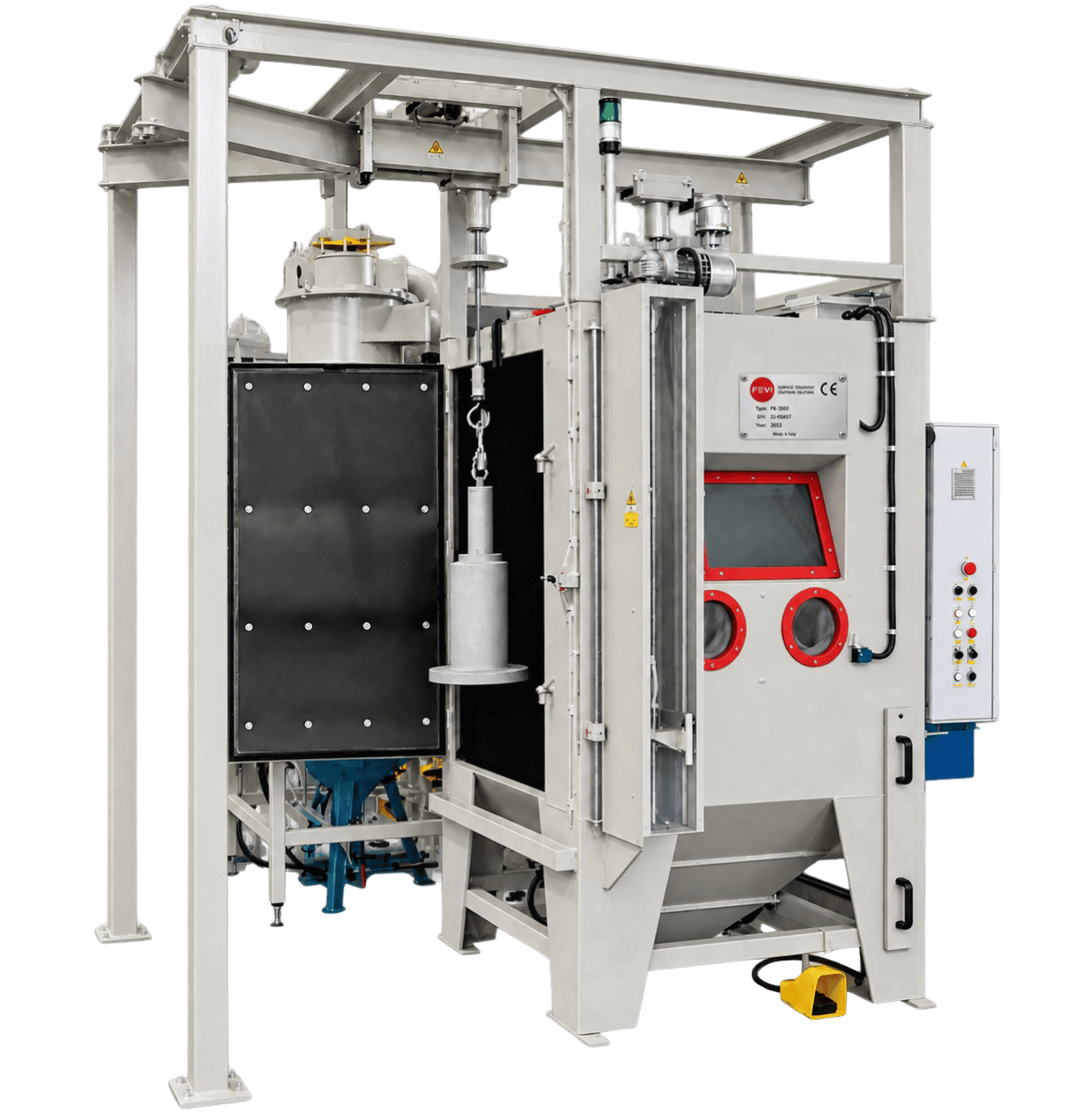
The machine integrates an upper structure dedicated to component handling, supported by an external frame functionally connected to the treatment area.
A suspension system is clearly visible, comprising:
- Overhead structure;
- Upper handling device;
- Vertical lifting element;
- Hook;
- Component connection system.
The component is kept suspended in front of the cabinet's operating area.
The machine also includes a manual operating station with:
- Viewing window;
- Two glove ports;
- Dedicated controls;
- Pneumatic connections;
- Foot control.
Internal protective elements are installed in the areas most exposed to the process, together with auxiliary systems connected to machine management.
The distinctive feature of this configuration is that the cabinet and overhead handling system have been designed as one integrated system, rather than treating component lifting as an operation external to the machine.
How the system works
The component is initially connected to the suspension system using the hook or the dedicated equipment specified for the part.
The overhead system then lifts the component and transfers it towards the treatment area.
Once the working position has been reached, the component remains suspended while the operator carries out the process through the front operating station.
The fact that the component does not necessarily need to rest on a support surface can leave side and lower surfaces more accessible, depending on its geometry and the selected lifting point.
Once treatment has been completed, the component can be moved again using the overhead system towards the designated unloading area.
The general operating sequence is:
Hooking → Lifting → Transfer → Positioning → Abrasive blasting or shot blasting → Exit → Unloading.
Why use an overhead handling system?
As component weight increases, manual handling becomes progressively less practical.
An overhead system allows the weight of the component to be supported by the handling structure rather than by the operator.
However, the advantage is not limited to weight alone.
Suspension can also be useful when the component has a complex shape or when resting it on a table would make some surfaces difficult to reach.
Overhead handling also makes it possible to define a precise path between the loading area, working position and unloading area.
In more complex applications, the same principle can be developed further to connect several stages of the production process.
The advantage of keeping the component suspended
A component resting on a support surface inevitably has a contact area.
If that same area needs to be treated, the component may have to be repositioned during the cycle.
Suspension instead makes it possible to select the lifting point according to the component and the surface that needs to be reached.
For three-dimensional or irregular components, this can improve accessibility during treatment.
The configuration is also suitable for components that should not be moved by rolling them or allowing them to come into contact with other parts.
The design principle is simple: the component is supported at the point that interferes least with the treatment.
- Overhead handling of the component;
- Possibility of managing heavy or bulky components;
- Reduced manual handling of the component;
- Possibility of keeping the component suspended during treatment;
- Reduced dependence on support surfaces;
- Potentially improved access to multiple surfaces;
- Possibility of designing the lifting point according to component geometry;
- Integration between lifting, transfer and the blasting area;
- Possibility of organising a defined entry and exit path;
- Configuration adaptable to different components and production cycles.
System features
| Element | Configuration |
|---|---|
| Type | Custom industrial blasting machine |
| Component handling | Overhead |
| Component support | Suspended hook |
| Upper system | Dedicated transport structure |
| Lifting | Integrated vertical system |
| Component transfer | By overhead structure |
| Position during treatment | Suspended component |
| Operator station | Manual |
| Visual inspection | Viewing window |
| Manual access | Two glove ports |
| Machine controls | Dedicated side control panel |
| Foot control | Included |
| Internal protection | Installed in the treatment areas |
| Hook rotation | Data not available |
| Overhead-system load capacity | Data not available |
| Lifting travel | Data not available |
| Transfer speed | Data not available |
| Abrasive | To be defined according to the application |
| Process | Abrasive blasting or shot blasting depending on the configuration |
Possible applications
A blasting machine with hook and overhead handling can be considered when the component is easier to manage by suspension than on a conventional worktable.
Possible applications include:
- Castings;
- Forged components;
- Welded structures;
- Pump bodies;
- Valve bodies;
- Casings;
- Gearboxes;
- Three-dimensional mechanical components;
- Fabricated metal components;
- Parts with irregular geometry;
- Heavy components;
- Parts with surfaces distributed across several sides;
- Delicate components that should not be moved by rolling;
- Components requiring a dedicated lifting system.
The final solution must nevertheless be designed around the actual component.
When handling becomes part of the blasting machine
In a customised industrial system, it is not always appropriate to consider the machine and handling system separately.
If the component needs to be lifted to enter the cabinet, kept suspended during treatment and then transferred to another position, these operations become part of the production cycle.
FEVI can therefore design not only the area in which blasting takes place, but also the way in which the component is hooked, lifted, transferred, positioned and unloaded.
Depending on the application, systems can be considered with:
- Hooks;
- Overhead handling;
- Monorails;
- Suspended trolleys;
- Lifting devices;
- Rotary tables;
- Floor trolleys;
- Roller conveyors;
- Automatic or semi-automatic systems.
Handling thus becomes a functional part of the machine.
A machine designed around the component
The FEVI blasting machine with hook and overhead handling is a particularly clear example of component-centred design.
The starting point is not simply the size of the cabinet.
It is necessary to know how much the component weighs, how it can be hooked, how far it needs to be lifted, which surfaces must remain accessible and how it must be transferred before and after treatment.
This information can then be used to define the machine configuration.
This approach allows FEVI to move from supplying a standard cabinet to designing an abrasive blasting or shot blasting system integrated with component handling.
Custom system or standard blasting cabinet?
Overhead handling is not necessary for every application.
For lightweight components that are easy to handle, a conventional cabinet may represent the simplest and most effective solution.
FEVI can therefore assess different configurations:
- Manual blasting cabinets;
- Professional blasting cabinets;
- Cabinets with rotary tables;
- Cabinets with trolleys;
- Systems with roller conveyors;
- Hook-type blasting machines;
- Shot blasting cabinets;
- Systems with overhead handling;
- Semi-automatic systems;
- Automatic abrasive blasting and shot blasting systems;
- Fully customised machines.
The ability to develop special-purpose systems also makes it possible to identify more precisely when a standard solution is already sufficient to achieve the required result.
Frequently asked questions – Blasting machine with hook and overhead handling
What is a blasting machine with hook used for?
It allows the component to remain suspended during handling and, where provided for by the configuration, during treatment. It can be useful for heavy, bulky components or parts that are difficult to support on a conventional worktable.
What is the advantage of overhead handling?
The overhead system transfers the weight of the component to the handling structure and makes it possible to organise the path between loading, treatment and unloading areas in a controlled manner.
Which components can be treated with a hook-type blasting machine?
The configuration can be suitable for castings, forged components, welded structures, machine bodies, valves, pumps, casings and other three-dimensional or heavy components that can be correctly suspended.
Can the hook rotate during blasting?
Hook systems can also be designed with component rotation where required by the process. This function must be defined during the design stage according to geometry, weight and the surfaces to be treated.
Can the load capacity of the system be designed according to component weight?
Yes. In a customised system, the structure, hook, lifting device and transport system must be sized according to the actual weight and characteristics of the component.
Can the system be integrated into a production line?
Overhead handling can also be developed as part of a more complex production path. The level of integration depends on the stations to be connected, the required cycle and the specified degree of automation.
Does FEVI also manufacture conventional blasting cabinets without overhead handling?
Yes. The hook system is considered where component handling makes it useful. For simpler applications, FEVI can provide standard blasting cabinets and other professional configurations.
Do you need to blast or shot blast a component that is difficult to handle?
When a component cannot be managed easily on a conventional worktable, the handling system can become an integral part of the blasting-machine design.
FEVI can analyse weight, dimensions, geometry and lifting method to identify the most appropriate configuration: from a conventional cabinet to a customised system with hook, lifting and overhead handling.
TELL US ABOUT YOUR PROJECT
For an initial assessment, you can provide:
- Photographs of the component;
- Material;
- Dimensions;
- Weight;
- Available lifting point or lifting method;
- Surfaces to be treated;
- Number of components;
- Current handling method;
- Required surface result.
First we study how to handle the component. Then we design how to treat it.