
 , Sandblasting machines with cabin



The project requirement
Explanation: When only a few components need to be blasted, the operator can position them individually and change their orientation during treatment.
The situation changes when the process involves numerous similar components, each with several surfaces that need to be reached.
Managing every component manually may mean repeatedly picking it up, rotating it, repositioning it and checking it.
The requirement therefore becomes creating continuous component movement capable of:
- Progressively changing their position;
- Exposing different surfaces to the process;
- Treating several components within the same cycle;
- Reducing the need to reposition each component manually;
- Making batch handling more repeatable.
The technical response: this requirement led to the integration of a tumbling belt inside the blasting cabinet.
Application analysis
A system of this type should not be selected solely according to the number of components.
Before the system is designed, the characteristics of the components must be analysed carefully.
Particularly important factors include:
- Dimensions;
- Weight of each component;
- Quantity per batch;
- Geometry;
- Material;
- Presence of edges or delicate features;
- Possibility of components coming into contact with one another;
- Required surface result;
- Abrasive used;
- Treatment time;
- Loading and unloading method.
The tumbling principle is particularly suitable when components can be moved together without mutual contact compromising their geometry or surface.
A particularly delicate, very thin or easily deformable component, or one with geometries that could become entangled with other parts, may instead require a different handling solution.
The design must therefore start from the component, not simply from the quantity to be treated.
The solution designed by FEVI
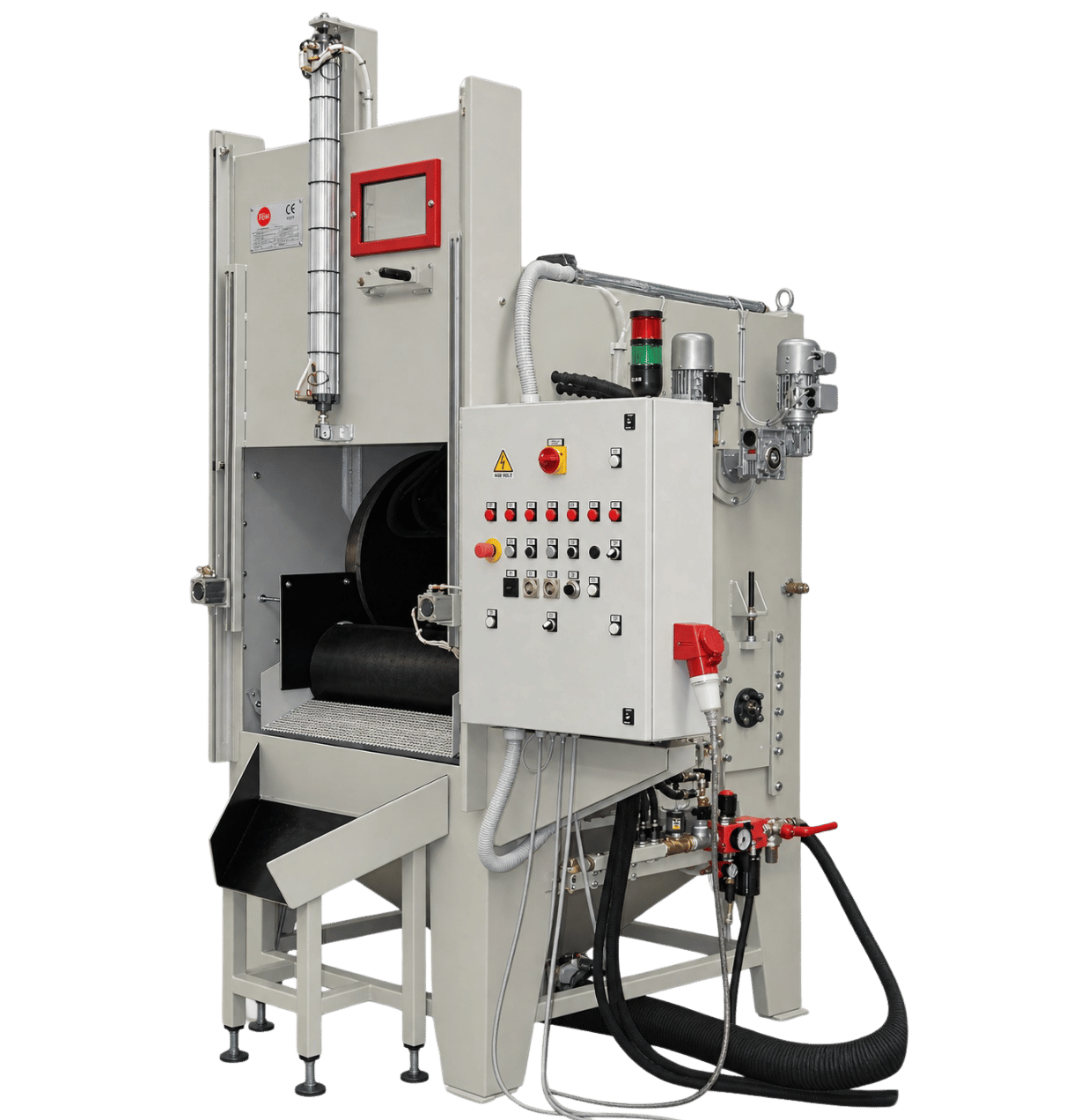
The FEVI system integrates a belt inside the treatment area for handling and tumbling the components.
The working chamber is fitted with an internally shaped belt designed to contain the components during treatment.
Belt movement allows the components in the batch to progressively change position, preventing the same surface from remaining constantly oriented in the same direction.
The machine also includes:
- Enclosed industrial structure;
- Internal handling system;
- Viewing window;
- Dedicated control unit;
- Electrical control panel with multiple controls;
- Machine-status indicator light;
- Drive systems;
- Pneumatic connections;
- Process pipework;
- Front unloading system;
- Lower structure dedicated to material management.
The configuration demonstrates how FEVI has designed treatment, handling and batch management as parts of the same system.
How the blasting cabinet with tumbling belt works
The components are introduced into the working area and placed on the belt.
During the cycle, the belt moves and progressively tumbles the components.
This movement continuously changes the relative orientation of the parts, bringing different surfaces into the treatment area.
This means that each component does not need to remain in a predetermined position throughout the entire cycle.
The process logic is:
Batch loading → Belt start → Component tumbling → Progressive treatment of surfaces → Cycle completion → Unloading.
The configuration therefore uses the movement of the components themselves as a functional part of the treatment process.
Why use a tumbling belt?
The main advantage comes from the ability to treat several components together without having to manage the orientation of each one manually.
Where components can move in contact with one another, the belt progressively presents different surfaces to the treatment area.
This principle is particularly useful for repetitive treatment of small and medium-sized components manufactured in series or otherwise handled in batches.
The belt therefore performs two functions: it supports the batch while continuously changing the arrangement of the components.
It is not simply a transport system. It is an active part of the process.
The component must be suitable for tumbling
This is a fundamental criterion when selecting the machine.
Not every component is suitable for treatment with a tumbling belt.
The solution is particularly suitable when components can:
- Move freely within the batch;
- Change position without deforming;
- Withstand the mutual contact involved in the process;
- Avoid becoming entangled with one another;
- Maintain their functional characteristics unchanged during tumbling.
For very delicate components or parts that must not come into contact with one another, FEVI can instead assess other configurations such as rotary tables, hooks, trolleys, roller conveyors or dedicated handling systems.
The choice of technology therefore depends first on the component and then on the machine.
- Simultaneous treatment of several components;
- Continuous movement of components during the cycle;
- Progressive exposure of different surfaces;
- Reduced manual repositioning of individual components;
- Possibility of batch processing;
- More rational management of repetitive production;
- Handling integrated directly into the treatment chamber;
- Possibility of configuring the cycle according to the component;
- Greater continuity between loading, treatment and unloading;
- Possibility of developing different levels of automation.
System features
| Element | Configuration |
|---|---|
| Type | Custom industrial blasting cabinet |
| Treatment mode | Batch |
| Component handling | Internal tumbling belt |
| Belt function | Component handling and tumbling |
| Treatment chamber | Integrated into the machine structure |
| Visual inspection | Viewing window |
| Control system | Dedicated electrical control panel |
| Machine-status indication | Stack light |
| Drive systems | Included |
| Pneumatic connections | Included |
| Process pipework | Included |
| Unloading system | Front-mounted |
| Number of components per cycle | To be defined according to the application |
| Load capacity | Data not available |
| Belt speed | Data not available |
| Speed adjustment | Data not available |
| Cycle duration | To be defined according to the application |
| Abrasive | To be defined according to the application |
| Process | Abrasive blasting or shot blasting depending on the required configuration |
Possible applications
A blasting cabinet with tumbling belt can be considered for small and medium-sized components that can be moved together during treatment.
Possible applications include:
- Small castings;
- Forged components;
- Small metal parts;
- Brackets;
- Small supports;
- Stamped components;
- Machined parts;
- Series-produced metal components;
- Industrial small parts;
- Heat-treated components;
- Small fabricated metal components;
- Components requiring treatment on several sides.
Compatibility must always be verified according to geometry, weight, material and the possibility of contact between components.
From single-component treatment to batch management
This configuration represents an important change compared with a conventional cabinet.
In a standard blasting machine, the operator mainly manages one component at a time.
With a tumbling belt, the design focus instead shifts to the behaviour of the entire batch during the cycle.
It is therefore necessary to determine:
- How many components must be loaded;
- How they are distributed on the belt;
- How they move during tumbling;
- How much contact between them is acceptable;
- Which surfaces must be reached;
- How they must be unloaded.
Handling is not added to the machine afterwards: it is designed together with the process.
Batch abrasive blasting and shot blasting
When components can be treated together, continuous movement progressively brings different surfaces into the process area.
Depending on the material, abrasive and required result, a configuration of this type can be designed for different surface-treatment operations.
The choice between abrasive blasting and shot blasting, as well as the choice of abrasive, must be made according to the component material, initial surface condition and treatment objective.
The machine is therefore configured starting from the result that must be achieved on the component.
A machine designed around the component
The FEVI blasting cabinet with tumbling belt demonstrates that customising a machine does not necessarily mean increasing its dimensions.
In this case, customisation mainly concerns the way the components are managed during treatment.
If the requirement is to repeatedly process a large number of components, correctly designing their handling may be more important than simply increasing chamber size.
FEVI can analyse the component, quantity, geometry, material, abrasive and required result to identify the most appropriate treatment system.
Custom system or standard blasting cabinet?
Not every production process requires a tumbling belt.
When parts are treated individually or can be handled easily by the operator, a standard manual blasting cabinet may be the simpler solution.
FEVI can assess different configurations:
- Manual blasting cabinets;
- Professional blasting cabinets;
- Cabinets with rotary tables;
- Cabinets with trolleys;
- Roller-conveyor systems;
- Hook-type blasting machines;
- Cabinets with tumbling belts;
- Shot blasting cabinets;
- Batch-processing systems;
- Semi-automatic systems;
- Automatic abrasive blasting and shot blasting systems;
- Fully customised machines.
Special-purpose design is adopted when it provides a practical advantage in the process.
Frequently asked questions – Blasting cabinet with tumbling belt
What is a blasting cabinet with tumbling belt used for?
It is used to treat several components at the same time, moving them during the cycle so that different surfaces are progressively exposed to the process.
What is the difference compared with a conventional blasting cabinet?
In a conventional cabinet, the component is generally positioned and handled individually. A tumbling belt instead makes it possible to process a batch of components and continuously change their arrangement during treatment.
Which components can be treated with a tumbling belt?
The solution can be suitable for small and medium-sized components that are sufficiently robust to withstand the movement and mutual contact involved in the process. Geometry and material must be assessed on a case-by-case basis.
Do the components move during blasting?
Yes. It is the movement of the belt that tumbles the batch and progressively changes the orientation of the components.
Can delicate components be treated?
It depends on the component. If mutual contact could cause deformation, unwanted scratches or damage, it may be preferable to use a system in which the components are kept separate.
Can the belt be sized according to production requirements?
In a customised system, working-area capacity, belt characteristics and cycle management are defined according to the components and the quantity to be treated.
Can this configuration also be used for shot blasting?
It can also be considered for shot blasting processes where the material, component geometry, abrasive and required result are compatible with the system. The configuration must be defined according to the application.
Do you need to treat numerous components without repositioning them one by one?
When components can be processed in batches, automatic component handling can become an integral part of the abrasive blasting or shot blasting process.
FEVI can analyse the components, quantity, material, geometry and required result to identify the most appropriate configuration: from a conventional cabinet to a customised system with tumbling belt and batch-cycle management.
TELL US ABOUT YOUR PROJECT
For an initial assessment, you can provide:
- Photographs of the component;
- Material;
- Dimensions;
- Weight of each component;
- Quantity to be treated per cycle;
- Required production rate;
- Whether contact between components is acceptable;
- Initial surface condition;
- Required surface result.
We start from the behaviour of the component during the process to design the machine.