 , Sandblasting machines with cabin


 The project requirement
Explanation: A cylindrical component presents a specific challenge: to treat its external surface uniformly, both the entire circumference and its longitudinal development must be reached.
In a manual cabinet, this may require the operator to:
- Continuously rotate the component;
- Progressively move the blasting gun;
- Maintain a sufficiently constant distance;
- Control the travel speed of the abrasive stream;
- Check that no areas remain insufficiently treated;
- Repeat the treatment several times on the same component.
As component dimensions or the number of parts to be treated increase, manually controlling all these variables can become inefficient.
The technical response: the design requirement therefore becomes creating coordinated movement between the surface and the projection system, transforming a repetitive operation into a more controllable cycle.
Application analysis
The design of a machine of this type must start from the geometry of the component.
The following must be assessed in particular:
- Diameter;
- Length;
- Weight;
- Regularity of the cylindrical geometry;
- Presence of ends, transitions or end sections;
- Material;
- Initial surface condition;
- Required result;
- Type of abrasive;
- Number of components to be treated;
- Desired cycle time;
- Required rotation speed;
- Required gun travel;
- Number and inclination of the nozzles.
Two movements are particularly important:
The first concerns the component, which must progressively present its circumference to the abrasive stream.
The second concerns the guns, which must cover the longitudinal development of the component.
When these two movements are properly coordinated, a repeatable treatment cycle can be built around the geometry of the component.
The solution designed by FEVI
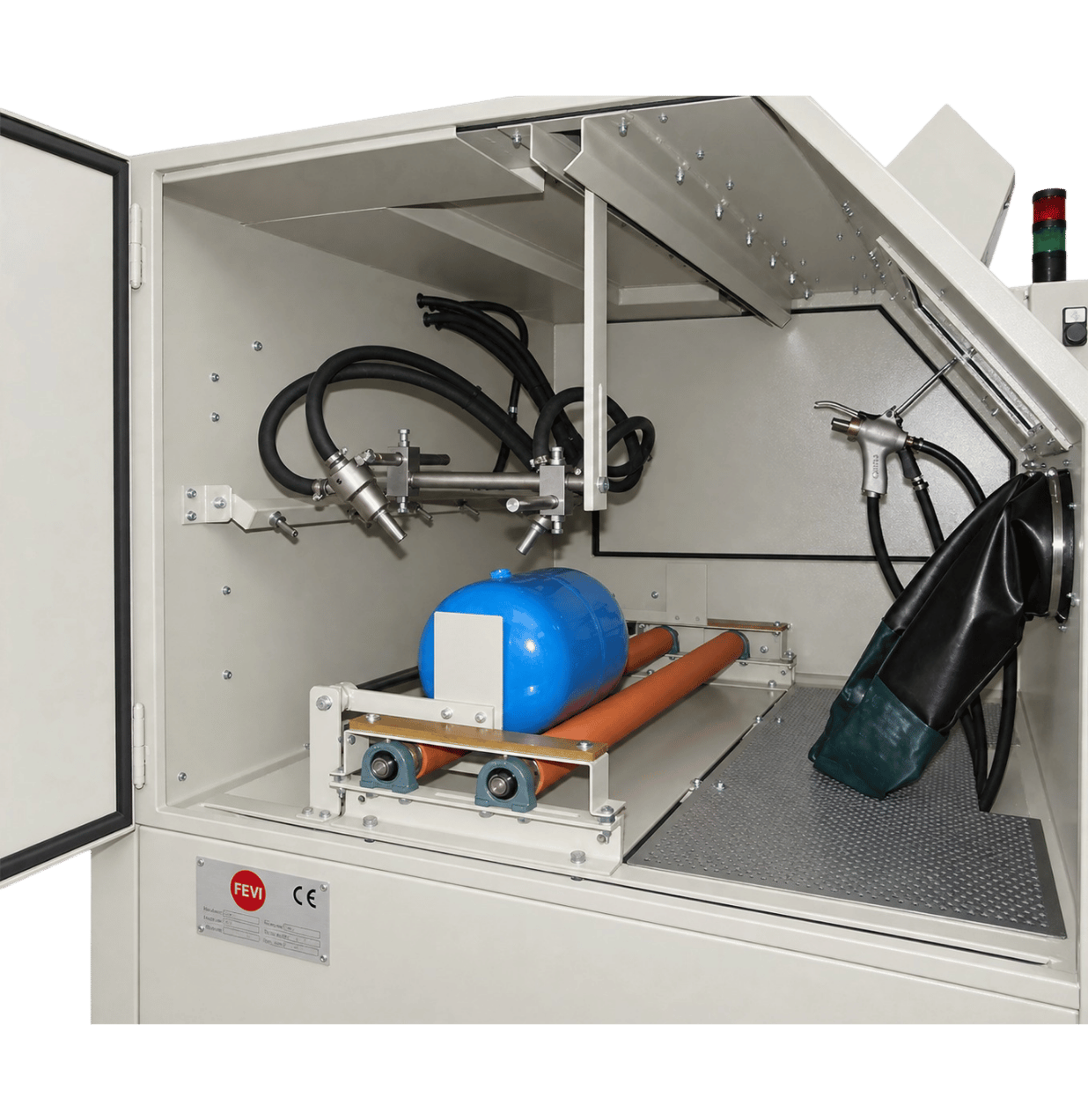
The FEVI machine features a working area equipped with two parallel rollers on which the cylindrical component rests.
This configuration keeps the component in position while allowing it to rotate around its own axis. The exact roller drive method must be defined according to the technical configuration of the system.
Above the component is a gun-support system with several nozzles mounted on a dedicated structure.
The assembly is configured for automatic horizontal movement, allowing the guns to travel along the length of the component.
The following are also visible:
- Multiple automatic blasting guns;
- Mechanical adjustment of the supports;
- Abrasive hoses;
- Internal structure dedicated to movement;
- Component-support rollers;
- Viewing window;
- Glove ports;
- Additional manual blasting gun;
- Internal lighting;
- Machine-status indicator light;
- Enclosed treatment chamber.
The presence of the manual blasting gun also allows, where necessary, finishing or inspection work to be carried out on specific areas.
How the system works
The cylindrical component is positioned on the rollers.
Once the component has been positioned, the automatic cycle can coordinate the movement specified for the component with the movement of the blasting guns.
The component can progressively rotate around its own axis while the automatic guns move horizontally along its length.
In this way, the abrasive stream does not remain concentrated on a single section, but progressively travels across the surface.
The combination of these movements makes it possible to cover:
component circumference + longitudinal development.
The cycle can therefore follow a sequence such as:
Loading → Positioning on the rollers → Start of rotation → Horizontal gun movement → Progressive treatment → Possible manual inspection/finishing → Unloading.
Parameters such as travel, speed, number of passes and gun position must be defined according to the application.
Why use rollers?
The rollers support a cylindrical component while leaving much of its external surface unobstructed.
Compared with a conventional support surface, the component can be moved around its own axis without having to be lifted and repositioned each time a different surface must be presented.
This principle is particularly effective when the surface to be treated extends around the entire circumference.
Rotation progressively presents the following areas to the abrasive stream:
- Upper section;
- Sides;
- Lower section;
- Opposite surface.
The component can therefore remain in the same overall position while continuously changing the surface exposed to the treatment.
Why move the blasting guns automatically?
Component rotation solves only part of the problem.
A cylindrical component may also have a considerable longitudinal development.
If the gun remained in a fixed position, treatment would mainly affect one band of the surface.
Automatic horizontal translation instead allows the guns to travel along the component's axis.
The movement can be designed according to:
- Useful length;
- Treatment speed;
- Number of passes;
- Abrasive-stream overlap;
- Component geometry;
- Required surface result.
The gun is therefore not simply automated: its movement is designed in relation to the movement of the component.
Rotation and translation: two complementary movements
It is precisely the combination of these two movements that defines this machine.
Rotation exposes the circumference. Gun translation covers the length.
By coordinating the two movements, it is possible to generate a treatment path that progressively covers the entire cylindrical surface.
This principle can help achieve a more uniform treatment than a process in which gun position, speed and rotation depend entirely on the operator's manual movement.
The configuration is therefore particularly suitable for repetitive production and applications where process consistency plays an important role.
The role of multiple blasting guns
Using several guns makes it possible to distribute treatment across a wider area or direct the abrasive streams towards different areas of the component.
The number, position and inclination of the guns must be designed according to the actual geometry of the component.
With suitable supports, the guns can be oriented to treat:
- Cylindrical surfaces;
- Transitions;
- Shoulders;
- Areas close to the ends;
- Specific geometries.
In a customised machine, nozzle arrangement therefore also becomes a design variable.
Automation and cycle control
Automation is not used solely to increase speed.
One of its main advantages is the ability to make the fundamental movements of the process repeatable.
For repetitive production, parameters consistent with the component can be defined, such as:
- Gun travel;
- Translation speed;
- Number of passes;
- Treatment time;
- Component rotation;
- Cycle sequence.
The actual level of adjustment available on the machine must be defined according to the specific configuration.
The design principle nevertheless remains that of reducing the variability introduced by completely manual handling.
- Dedicated support for cylindrical components;
- Possibility of moving the component around its own axis;
- Progressive treatment of the entire circumference;
- Multiple automatic blasting guns;
- Horizontal movement of the gun assembly;
- Progressive coverage of the longitudinal development;
- Reduced manual repositioning of the component;
- Possibility of setting a repeatable cycle;
- Improved control of the treatment path;
- Possibility of adapting gun travel and position to the geometry;
- Possibility of carrying out manual finishing where required;
- Configuration adaptable to the required productivity.
System features
| Element | Configuration |
|---|---|
| Type | Custom industrial blasting cabinet |
| Reference geometry | Cylindrical components |
| Component support | Double roller |
| Component movement | Rotation permitted on the rollers |
| Roller drive | Data not available |
| Projection system | Multiple blasting guns |
| Gun movement | Automatic horizontal movement |
| Gun movement direction | Longitudinal relative to the component |
| Gun-support adjustment | Included |
| Manual operating station | Included |
| Manual blasting gun | Included |
| Visual inspection | Viewing window |
| Manual access | Glove ports |
| Internal lighting | Included |
| Status indication | Stack light |
| Exact number of automatic guns | To be verified according to the technical configuration |
| Gun travel | Data not available |
| Translation speed | Data not available |
| Component rotation speed | Data not available |
| Maximum component diameter | Data not available |
| Maximum component length | Data not available |
| Abrasive | To be defined according to the application |
| Process | Abrasive blasting or shot blasting depending on the required configuration |
Possible applications
A blasting cabinet with rollers and automatic guns can be considered for components with cylindrical or predominantly axisymmetric geometry.
Possible applications include:
- Cylindrical vessels;
- Tanks;
- Cylinders;
- Cylindrical bodies;
- Industrial rollers;
- Shafts;
- Sleeves;
- Pipes of compatible diameter;
- Metal vessels;
- Large turned components;
- Welded cylindrical components;
- Components requiring uniform treatment around the circumference.
The solution must be sized according to the diameter, length, weight and surface characteristics of the component.
Treating cylindrical components differently
A cylindrical component should not be approached in the same way as a conventional flat component.
Its geometry naturally suggests a different approach to movement.
If the component is rotated, the surface itself progressively presents different areas to the projection system.
If the guns are simultaneously moved along the axis, treatment can follow the entire length of the component.
The geometry of the component therefore becomes the basis for designing the machine kinematics.
This is a fundamental principle in FEVI special systems: rather than forcing the component to adapt to a standard movement, the movements are designed to suit its geometry.
From manual treatment to an automatic cycle
A conventional manual cabinet remains an effective solution when components are occasional, easy to handle or very different from one another.
When similar components are treated repeatedly, automation can provide greater value.
Automatic gun movement makes it possible to convert operations that would otherwise depend entirely on the operator into machine parameters.
The manual gun can nevertheless retain an important role for:
- Inspections;
- Touch-ups;
- Specific areas;
- Geometries not reached by the main automatic cycle;
- Occasional applications.
Automation and manual intervention can therefore coexist within the same machine.
A machine designed around the component
The FEVI blasting cabinet with rollers and automatic horizontally moving guns clearly represents a design principle based on geometry.
The starting point is the component.
Is it cylindrical? What is its diameter? How long is it? How much does it weigh? Does the entire circumference need to be treated? Do the ends require different treatment? What degree of surface uniformity is required?
These answers can be used to define:
- Roller position;
- Rotation system;
- Number of guns;
- Nozzle inclination;
- Horizontal travel;
- Movement speed;
- Treatment sequence.
The machine is therefore developed from the relationship between component geometry and the path required by the abrasive stream.
Automatic system or standard blasting cabinet?
Not every cylindrical component requires an automatic system.
For occasional work or components that are easy to handle, a standard manual blasting cabinet may be sufficient.
FEVI can assess different solutions:
- Manual blasting cabinets;
- Professional blasting cabinets;
- Cabinets with rollers;
- Cabinets with rotary tables;
- Cabinets with automatic guns;
- Systems with oscillating guns;
- Shot blasting cabinets;
- Systems for cylindrical components;
- Semi-automatic systems;
- Automatic abrasive blasting and shot blasting systems;
- Fully customised machines.
The level of automation is defined according to the component, production frequency and required result.
Frequently asked questions – Blasting cabinet with rollers and automatic guns
What is a blasting cabinet with rollers used for?
The rollers support cylindrical components and allow them to move around their own axis, progressively presenting the entire circumference to the treatment area.
Why do the blasting guns move horizontally?
Horizontal translation allows the abrasive stream to travel along the longitudinal development of the component. Combined with component rotation, it progressively treats an extended cylindrical surface.
Which components can be treated?
The configuration can be considered for cylindrical vessels, tanks, cylinders, rollers, shafts, vessels and other predominantly cylindrical components. Dimensions and weight must be verified during the design stage.
Can the movement of the blasting guns be adjusted?
In an automatic system, travel, speed and movement sequence can be designed according to the component and required cycle. The actual adjustment possibilities depend on the specific machine configuration.
Do the rollers automatically rotate the component?
Roller systems can be designed with different drive methods. For this specific machine, the support and rotation principle is evident, while the exact drive method must be verified in the technical documentation.
Why use multiple automatic blasting guns?
Multiple guns make it possible to distribute the abrasive stream over different areas and to define their position and inclination according to the component geometry and the surface to be treated.
Can a manual blasting gun also be used?
Yes. The machine shown also includes a manual operating station, which can be useful for inspections, finishing or localised treatment not included in the main automatic cycle.
Do you need to repeatedly treat cylindrical components?
When the component must be treated around its entire circumference and along its length, coordinating component movement with gun movement can make the process considerably more rational.
FEVI can analyse geometry, dimensions, weight and the required result to design a dedicated configuration: from a manual cabinet to an automatic system with rollers and controlled gun movement.
TELL US ABOUT YOUR PROJECT
For an initial assessment, you can provide:
- Photographs of the component;
- Material;
- Diameter;
- Length;
- Weight;
- Quantity to be treated;
- Surfaces involved;
- Initial surface condition;
- Any abrasive already in use;
- Required surface result;
- Desired productivity.
We study the movement best suited to the component geometry and build the process around it.