
 , Sandblasting machines with cabin


The project requirement
Explanation: A conventional blasting cabinet is particularly effective when the component can be fully introduced into the working area, positioned on the internal support and moved easily by the operator.
As the longitudinal length of the component increases, or when weight and overall dimensions make lifting and repositioning difficult, the issue is no longer limited to blasting alone: it also becomes essential to design how the component enters the machine, how it is supported during processing and how it exits.
Profiles, pipes, bars, structural steelwork, structural components and other parts developed mainly in length may require progressive handling rather than conventional loading.
The technical response: the double roller conveyor addresses precisely this requirement by integrating a handling path into the cabinet that allows the component to be brought closer, positioned and transferred while remaining supported throughout the different stages of the process.
Application analysis
When designing a blasting cabinet with roller conveyors, the internal dimensions of the machine are only one of the variables to consider.
The cross-section of the component, its length, weight, support points, position of the surfaces to be treated, loading and unloading methods and the space required by the operator to correctly control the process must all be assessed.
The roller conveyor therefore also becomes an integral part of the design. Roller diameter and arrangement, conveyor height, length of the external sections and method of advancement must be defined according to the component.
The objective is to create a system in which the cabinet and handling equipment work as a single solution, avoiding the need to adapt the production process to a standard machine.
The solution designed by FEVI
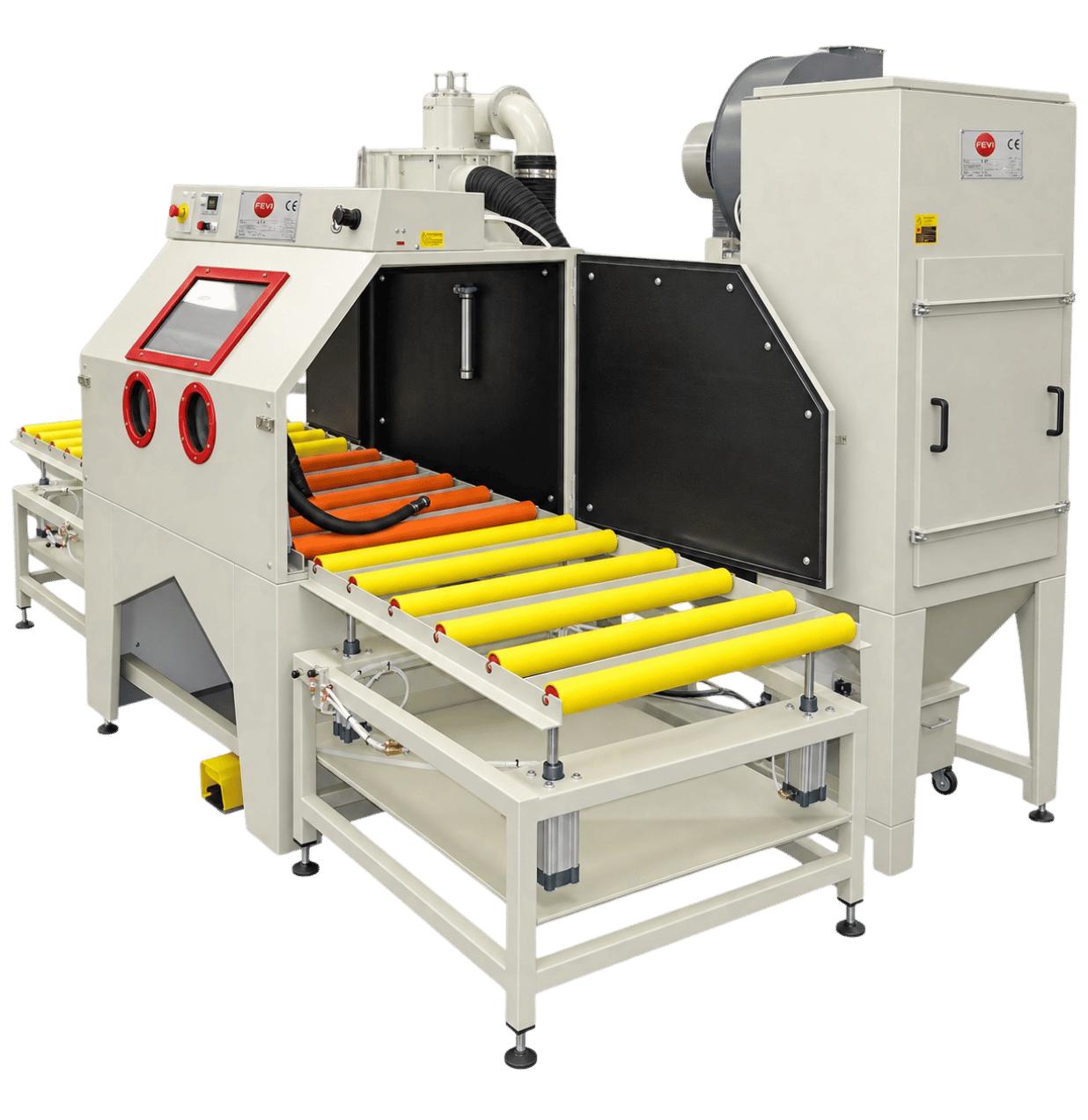
The FEVI solution integrates the blasting cabinet with two roller-conveyor structures positioned on opposite sides of the treatment area.
This arrangement creates a through-feed path that supports the component before entry, during positioning and during the subsequent exit stage.
The operator station is equipped with a viewing window and two front glove ports, allowing the operator to visually inspect the surface and work on the component from inside the cabinet.
The internal areas most exposed to the process are fitted with dedicated protective linings, while pneumatic components associated with the mechanical functions required by the specific configuration are visible on the roller-conveyor structure.
The system also includes a separate unit connected to the cabinet for process-air management and an upper unit integrated into the machine circuit.
The presence of these different subsystems highlights a fundamental principle in the design of a special-purpose system: it is not simply the cabinet that is modified, but the entire set of elements required to make the complete production cycle functional.
How the double roller-conveyor blasting cabinet works
The component is positioned on the infeed roller conveyor and guided towards the treatment area.
Once the correct working position has been reached, the operator monitors the component through the front viewing window and works through the glove ports.
The component can then be advanced to present a new section of the surface to the working area. Treatment can therefore proceed in successive sections while keeping the component supported along its direction of travel.
Once the process has been completed, the component can continue towards the roller conveyor positioned on the opposite side of the cabinet.
This configuration therefore makes it possible to separate the overall length of the component from the useful dimensions of the treatment area, allowing applications to be considered that could be difficult to manage with a conventional enclosed cabinet.
Why choose a double roller-conveyor configuration?
The main advantage is not simply the presence of the rollers, but the way they change the relationship between the operator, the component and the treatment area.
A long component may be too bulky to fit completely inside a cabinet even though its cross-section is perfectly compatible with the working area.
Through-feed handling instead makes it possible to progressively bring only the section that needs to be treated into the cabinet.
The same principle can be useful when the component is difficult to lift or reposition: by keeping it supported on the roller conveyor, handling operations can be organised more rationally.
The design can also be developed further according to production requirements by considering manual, assisted or automated handling systems.
- Easier handling of long or bulky components;
- Continuous support of the component throughout the different processing stages;
- Progressive treatment of surfaces along the length of the component;
- Reduced need to continuously lift and reposition the component;
- Functional connection between loading, blasting and unloading;
- Possibility of sizing both the cabinet and handling system according to the application.
System features
| Element | Configuration |
|---|---|
| Type | Custom industrial blasting cabinet |
| Configuration | Through-feed |
| Handling | Opposing double roller conveyors |
| Operator area | Front manual operating station |
| Process monitoring | Viewing window |
| Manual access | Two glove ports |
| Internal protection | Protective linings in the areas most exposed to the process |
| Roller conveyors | Dedicated infeed and outfeed structures |
| Pneumatic components | Installed on the handling structure |
| Operator control | Machine controls and foot pedal |
| Process-air management | Dedicated unit connected to the cabinet |
| Upper process unit | Included and connected to the machine |
| Abrasive | To be defined according to the application |
| Useful dimensions | To be defined according to the component |
| Roller-conveyor load capacity | Data not available |
| Level of automation | To be defined according to the project |
Possible applications
A blasting cabinet with double roller conveyor can be considered when the geometry of the component makes a longitudinal processing path advantageous.
The configuration can be designed for the treatment of metal profiles, pipes, bars, beams, structural steelwork, welded structures, elongated mechanical components and other parts requiring continuous support during handling.
The principle is not limited to a single product category. Analysis of the component determines whether a roller conveyor is genuinely the most appropriate solution or whether a rotary table, trolley, lifting system or another configuration would be preferable.
A machine designed around the component
For FEVI, designing a customised system means starting from the component that must be treated.
Dimensions, weight, geometry, material, surfaces to be reached, abrasive, handling requirements, number of parts and required result all contribute to defining the machine.
The double roller-conveyor blasting cabinet provides a practical example of this approach: component handling becomes an integral part of the blasting system and is designed together with the treatment area.
A special-purpose machine is therefore not created simply by adding accessories to an existing cabinet, but by analysing the complete process.
Custom system or standard blasting cabinet?
Not every application requires a special solution.
When the dimensions, weight and geometry of the component allow conventional loading and handling, a standard blasting cabinet may represent the simplest and most rational solution.
FEVI can therefore start from the application and identify the level of customisation actually required: from a traditional manual cabinet to semi-automatic configurations, systems with dedicated handling equipment and installations developed specifically around the production process.
The ability to design complex systems also makes it possible to determine more accurately when the machine does not need to be made more complex and a standard solution is instead the correct choice.
Frequently asked questions about the double roller-conveyor blasting cabinet
What is a blasting cabinet with double roller conveyor used for?
It facilitates the loading, support and handling of components that, due to their length or overall dimensions, are difficult to manage inside a conventional cabinet. The component can be progressively advanced through the treatment area.
Which components can be blasted in a roller-conveyor cabinet?
The configuration can be considered for profiles, pipes, bars, beams, structural steelwork and other components developed mainly in length. The choice nevertheless depends on dimensions, weight, geometry and the required process.
Why are two roller conveyors used?
One roller conveyor supports the component in the infeed area while the opposing conveyor supports its onward movement after treatment. This creates a through-feed path through the cabinet.
Can a component longer than the cabinet be treated?
A through-feed configuration makes it possible to consider progressive treatment of components whose overall length exceeds that of the working area, provided that their cross-section, weight and handling requirements are compatible with the machine design.
Can the roller conveyors be automated?
During the design stage, different handling systems can be considered according to the component and required productivity. The level of automation must be defined on a case-by-case basis.
Can the cabinet be designed around the dimensions of my component?
Yes. In a customised system, cabinet dimensions, useful opening, roller-conveyor height and handling system are assessed starting from the characteristics of the component and the required process.
Does FEVI also manufacture conventional blasting cabinets?
Yes. When the application does not require special handling or dedicated configurations, FEVI can provide standard professional systems. A special solution is developed when the component or production cycle requires specific features.
Do you have a component that a standard cabinet cannot handle?
Machine size is not the only parameter to consider. Weight, geometry, handling requirements and the surfaces that need to be reached can determine the entire system configuration.
FEVI can analyse the application and assess the most appropriate solution, from a conventional blasting cabinet to a customised abrasive blasting or shot blasting system developed around a specific requirement.
TELL US ABOUT YOUR PROJECT
Send FEVI the following information:
- Photographs of the component;
- Material and type of component;
- Dimensions and approximate weight;
- Number of parts to be treated;
- Required surface result.
We start from the component to design the solution.