
 , Sandblasting machines with cabin


 The project requirement
Explanation: A conventional cabinet with a single viewing window and two glove ports is effective when the component dimensions are compatible with the operator's working reach.
As the component increases in width, depth or geometric complexity, it can become difficult to reach all surfaces correctly while working from a single position.
Under these conditions, several requirements may arise:
- Need to access distant areas of the same component;
- Treatment of bulky components;
- Need to reduce repeated repositioning of the component;
- Possibility of working from two different points on the cabinet;
- Need to load the component through a very large opening;
- Improved organisation of component loading and unloading stages.
The technical response: the dual operating-station configuration is therefore designed to extend the working area without relying entirely on manual repositioning of the component.
Application analysis
The design of a cabinet of this type must start from the actual surface area that needs to be reached during treatment.
Knowing only the external dimensions of the component is not sufficient.
The following must be assessed:
- Width;
- Height;
- Depth;
- Weight;
- Geometry;
- Surfaces to be treated;
- Distance between the operator and the component;
- Loading method;
- Any need to rotate or move the component;
- Number of components to be treated;
- Required productivity.
On a very wide component, a single operating position may force the operator to work at less favourable angles or make it necessary to continuously change the position of the part.
A dual operating station instead allows access to the working area to be distributed across a larger front surface.
The solution designed by FEVI
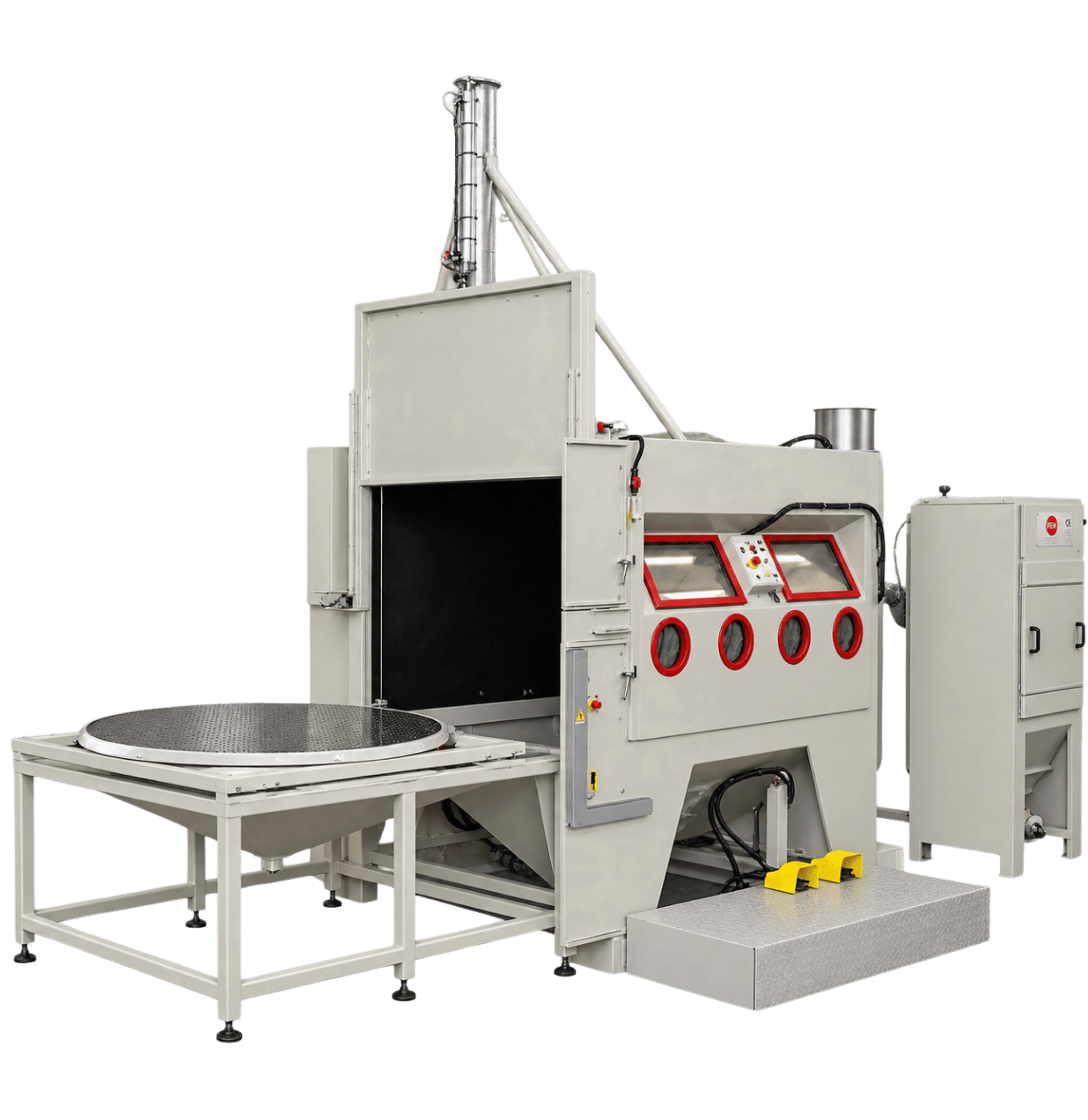
The FEVI system features a large treatment chamber with an automatic front opening.
The door moves vertically, freeing a large section for component loading.
Two separate operating stations are visible on the front of the machine, each equipped with:
- Viewing window;
- Pair of glove ports;
- Access to the internal area of the cabinet.
The machine therefore has a total of two viewing windows and four glove ports.
This configuration increases the extent of the reachable area compared with a single operating station.
The machine also includes:
- Dedicated support structure;
- Large internal treatment area;
- Front support/table for component positioning;
- Centralised controls;
- Pneumatic connections;
- Foot control;
- Separate extraction and filtration unit;
- Upper system connected to process management.
The machine is therefore designed not simply as an enlarged cabinet, but as a system in which loading, component accessibility and operator stations have been integrated into the same project.
How the system works
The cycle begins with the opening of the automatic door.
The large front area allows the component to be positioned in the correct working position.
Once loading has been completed, the door is closed and the cabinet is prepared for treatment.
The operator can work using either of the two available stations.
When the geometry of the component requires it, the operator can move to the second operating position to reach different surfaces without necessarily having to reposition the entire component.
In a configuration specifically designed for simultaneous operation, the dual station can also be used to organise work from two different points.
Once treatment has been completed, the door is reopened and the component can be removed from the working area.
The system logic is:
Large-area loading → Automatic closure → Treatment from the first position → Access from the second position → Completion → Unloading.
Why use a dual operator station?
The main advantage of a dual station is the increase in the accessible area of the component.
A single station inevitably defines a specific operating reach.
Increasing the size of the machine without changing the operator's position can therefore create a large internal area that is not completely reachable in a practical way.
With two adjacent stations, the operator can instead approach the surface from two different points.
This principle can be particularly useful when treating:
- Wide components;
- Complex structures;
- Components with surfaces distributed across different areas;
- Parts requiring treatment in multiple zones;
- Components that cannot be easily moved during the cycle.
The dual station therefore becomes an ergonomic and accessibility solution, not simply an increase in machine dimensions.
Why use an automatic vertical door?
A large hinged opening would require free space in front of or beside the machine.
A vertical door instead uses the space above the cabinet, leaving the loading area more accessible.
When the closure is large and heavy, automation also makes its movement more practical.
The door is therefore not simply a closing element.
It becomes part of the component-handling system: it fully opens the loading area, allows the component to be positioned and then closes the chamber before treatment.
Dual station: one or two operators?
The presence of two operating stations does not necessarily mean that two operators must always work simultaneously.
The configuration can serve two different purposes.
The first is to allow a single operator to move between two positions in order to reach different surfaces more effectively.
The second, where the design and process specifically provide for it, is to allow organised work from two operating stations.
The choice depends on component dimensions, required productivity and treatment method.
This is one of the aspects defined during system design.
- Large loading opening;
- Automatic vertical door;
- Two front operating stations;
- Two viewing windows;
- Four glove ports;
- Greater extent of the reachable area;
- Improved accessibility to wide or complex components;
- Reduced need to continuously reposition the component;
- Possibility of organising the process from different positions;
- Possibility of sizing the chamber according to the component;
- Integration between loading and the working area;
- Configuration adaptable to different levels of automation.
System features
| Element | Configuration |
|---|---|
| Type | Custom industrial blasting cabinet |
| Component access | Large front opening |
| Door | Automatic vertical door |
| Operating stations | Two |
| Viewing windows | Two |
| Glove ports | Four |
| Operating mode | Manual |
| Loading table | Front-mounted |
| Treatment chamber | Large |
| Controls | Centralised |
| Foot control | Included |
| Pneumatic connections | Included |
| Extraction | Dedicated unit |
| Air-management system | Integrated into the system |
| Simultaneous use by two operators | To be defined according to the project |
| Useful dimensions | To be defined according to the component |
| Maximum component weight | Data not available |
| Loading-table movement | Data not available |
| Abrasive | To be defined according to the application |
| Process | Abrasive blasting or shot blasting depending on the required configuration |
Possible applications
A dual-station blasting cabinet can be considered when the component has dimensions or geometries that make an extended operating access area useful.
Possible applications include:
- Large mechanical components;
- Welded structures;
- Fabricated metalwork;
- Frames;
- Castings;
- Moulds;
- Wide industrial components;
- Metal panels;
- Machine bodies;
- Three-dimensional structures;
- Components requiring treatment in several areas;
- Parts that are difficult to reposition during the cycle.
The configuration must nevertheless be defined starting from the actual component and the required surface result.
When increasing cabinet size is not enough
A larger machine is not necessarily a more functional machine.
If chamber width is increased without considering the operator's position, some areas may become difficult to reach.
The design must therefore consider simultaneously: chamber size + component size + operator position.
The dual operating station provides a response to this relationship.
Instead of requiring the component to be continuously moved towards the operator, it is possible to create multiple positions from which the operator can reach the component.
This approach improves the overall logic of the machine.
A machine designed around the component
The FEVI blasting cabinet with automatic door and dual operating station demonstrates how a customised system can originate from an apparently simple requirement: correctly reaching all surfaces of a large component.
The solution does not necessarily consist simply of building a larger cabinet.
Instead, it is necessary to analyse:
- Where the component must be positioned;
- How much space it needs around it;
- Which surfaces need to be reached;
- From how many positions the operator needs to work;
- How loading must be carried out;
- How the chamber must be opened and closed.
The design develops from these variables.
FEVI can therefore configure the machine according to the complete treatment process, rather than only the nominal dimensions of the cabinet.
Custom system or standard blasting cabinet?
For components of normal dimensions that are easy to reach, a standard single-station blasting cabinet may represent the simplest and most effective solution.
As component size, weight or complexity increase, specific configurations may instead become useful.
FEVI can assess:
- Standard blasting cabinets;
- Professional blasting cabinets;
- Dual-station cabinets;
- Cabinets with rotary tables;
- Cabinets with trolleys;
- Cabinets with roller conveyors;
- Hook-type blasting machines;
- Systems with automatic doors;
- Shot blasting cabinets;
- Semi-automatic systems;
- Automatic abrasive blasting and shot blasting systems;
- Fully customised machines.
Design capability makes it possible to determine how much customisation the machine actually requires, avoiding unnecessarily complex solutions when a standard configuration can already meet the process requirements.
Frequently asked questions – Blasting cabinet with automatic door and dual operating station
What is a dual-station blasting cabinet used for?
It allows the component to be reached from two different operating positions, increasing the extent of the accessible area compared with a conventional cabinet with a single viewing window and two glove ports.
Does a dual-station cabinet require two operators?
Not necessarily. The two stations can also allow a single operator to move between two areas of the machine. Any simultaneous use by two operators must be specifically provided for in the design.
For which components is a dual station useful?
It can be suitable for wide, bulky or three-dimensional components, or parts that are difficult to reposition during treatment.
What is the advantage of the automatic vertical door?
It creates a large front opening without requiring the space needed for the movement of a large hinged door. Automation also facilitates the movement of a large closure.
Can the distance between the operating stations be customised?
In a custom-designed machine, the position of the windows and glove ports, together with chamber dimensions, can be defined according to the size and geometry of the component.
Can the machine also be used for shot blasting?
The configuration can be designed for different processes. Abrasive, projection system, recovery system and internal protection must be defined according to the material and the required surface result.
Does FEVI also manufacture single-station cabinets?
Yes. When the component can be treated easily from a single position, a standard or customised single-station cabinet may represent the most rational solution.
Do you need to treat a component that is too large for a conventional operating station?
As the size and complexity of the component increase, simply increasing the size of the cabinet is not enough.
It is also necessary to assess where the operator needs to reach the different surfaces from and how the component must be loaded.
FEVI can analyse the process and design the most appropriate solution: from a conventional cabinet to a system with automatic door, dual operating station and dedicated handling systems.
TELL US ABOUT YOUR PROJECT
For an initial assessment, you can provide:
- Photographs of the component;
- Material;
- Dimensions;
- Weight;
- Surfaces to be treated;
- Number of components;
- Loading method;
- Any need to work from multiple positions;
- Required surface result.
We size the machine around the component and the actual working area required.