
 , Sandblasting machines with cabin


The project requirement
Explanation: A standard blasting cabinet concentrates the operator's work at a single station.
This solution is effective when the component can be fully reached from the designated position or when it can be moved easily inside the chamber.
The problem changes when the component has:
- Considerable longitudinal dimensions;
- Large overall dimensions;
- Numerous surfaces to be treated;
- Complex geometry;
- Handling difficulties;
- High weight;
- A requirement to work on areas far apart from each other;
- Production cycles requiring several access points.
Under these conditions, simply increasing the size of the chamber may not be sufficient.
A very large cabinet with only one operating station might contain the component perfectly while still preventing the operator from easily reaching all its surfaces.
The technical response: the design must therefore consider not only how much space is required to contain the component, but also from which positions it must be possible to treat it.
Application analysis
The design of a multi-position blasting cabinet must start from the actual geometry of the component and the extent of the surface to be treated.
The following must be analysed:
- Length;
- Width;
- Height;
- Weight;
- Geometry;
- Loading method;
- Surfaces to be treated;
- Reach available from each station;
- Any internal or recessed areas;
- Need to work simultaneously or sequentially;
- Expected number of operators;
- Required productivity.
The stations must not be distributed randomly.
Their position must be designed in relation to the component and the portion of surface that each station must allow the operator to reach.
The objective is to create continuous operational coverage of the working area.
The solution designed by FEVI
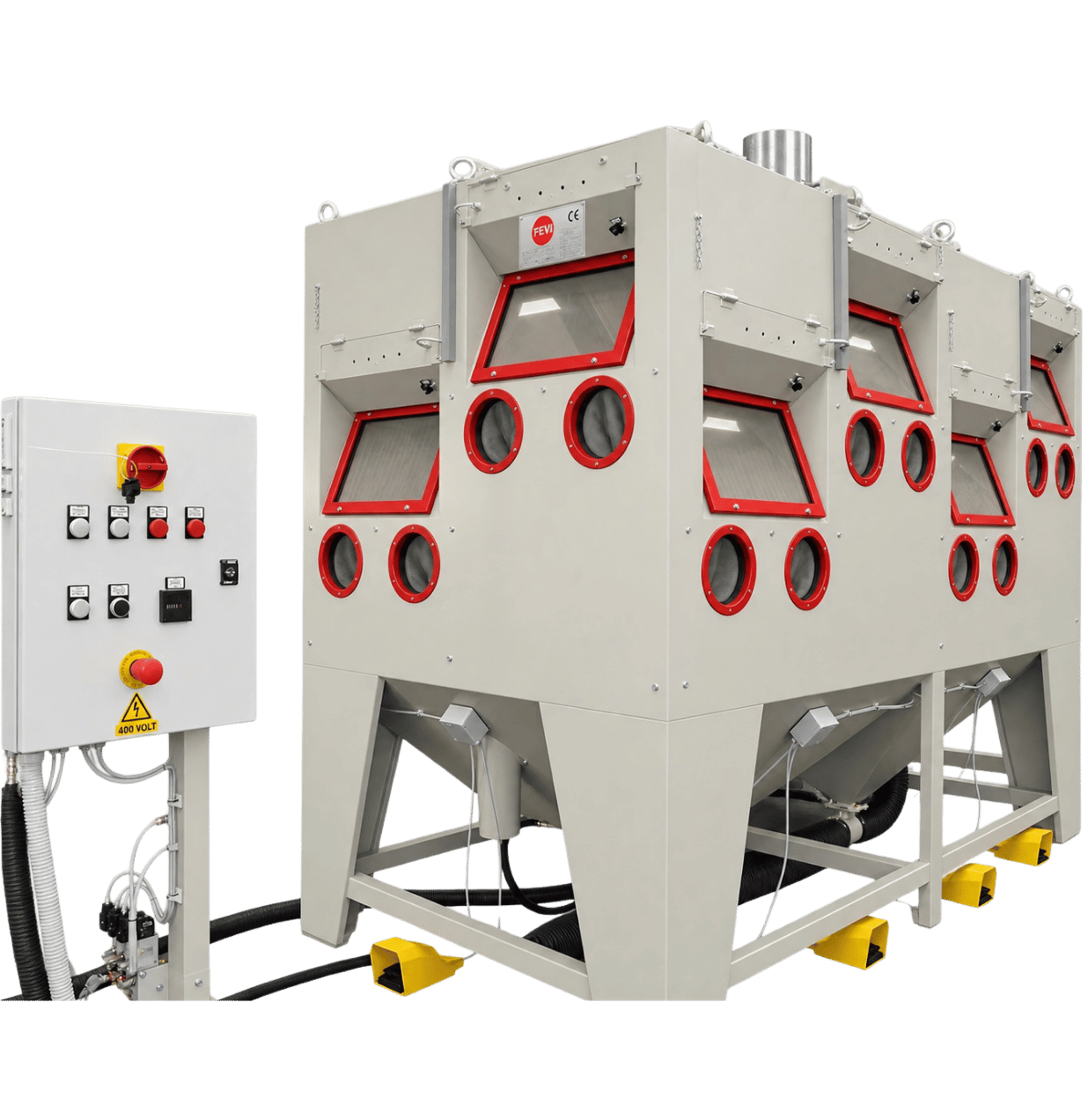
The FEVI machine features a large industrial chamber equipped with several operating stations distributed along the structure.
Several configurations can be seen, each comprising:
- Viewing window;
- Pair of glove ports;
- Internal lighting;
- Structure dedicated to the individual operating area.
The stations are positioned along different sections of the cabinet, allowing access to the chamber from several points.
The lower structure incorporates collection hoppers, while pipework connected to the process system can be seen beneath the machine.
An external centralised electrical control panel is also provided with:
- Machine controls;
- Operating push buttons;
- Emergency stop;
- Electrical management of the system.
The configuration shows how the machine was conceived as one large treatment chamber served by multiple operating points.
How a multi-position blasting cabinet works
The component is introduced into the chamber and positioned in the area defined by the design.
During treatment, the operator can use the different stations according to the surface that needs to be reached.
A first area of the component can be treated from one station, while subsequent areas can be reached by moving along the cabinet.
Where the system configuration and operating procedures permit, a multi-position cabinet can also be designed to distribute the work between several operators.
The general principle therefore becomes:
Loading → Positioning → Treatment from the first station → Moving to subsequent stations → Completion of the different areas → Unloading.
The actual sequence depends on the component and the intended production organisation.
Why use multiple operating stations?
The main advantage is the possibility of increasing the reachable area without necessarily having to move a large component continuously.
Each station creates its own operating area.
By distributing several stations along the machine, a sequence of working areas can be created which, together, cover a much larger surface than can be reached from a single position.
This principle can be particularly useful when the component is:
- Long;
- Heavy;
- Bulky;
- Difficult to rotate;
- Complex to handle;
- Characterised by numerous distributed surfaces.
Instead of continuously bringing the component to the operator, the operator has multiple access points to the component.
A large cabinet is not necessarily a functional cabinet
In special-purpose machines, dimensions must not be considered separately from ergonomics.
A very large chamber can accommodate a substantial component, but this does not guarantee that all surfaces can be reached correctly.
The design must relate:
Chamber dimensions + Component geometry + Station position + Operator working reach.
The multi-position configuration is created precisely from this relationship.
It is not simply a matter of adding more pairs of gloves: each position becomes part of the machine's functional geometry.
Can one or more people use a multi-position cabinet?
The presence of several stations does not automatically mean that all of them must be used at the same time.
Two operating approaches are possible:
The first involves a single operator moving between the different positions during the process.
The second may involve, where design, safety and the production cycle permit, several operators working at the same time.
The choice must be defined during the design stage, taking into account:
- Machine dimensions;
- Blasting system;
- Available compressed air;
- Extraction;
- Number of blasting guns;
- Cycle organisation;
- Safety;
- Required productivity.
For the machine shown, the actual number of simultaneous operators must be verified against the original technical documentation.
Distributing treatment along the component
A multi-position cabinet can be particularly useful when the component has considerable longitudinal development.
Instead of creating one central station and continuously moving the component, a sequence of access points can be created along the machine.
Each position allows the operator to reach the nearest portion of the component.
This approach can be suitable for:
- Metal structures;
- Frames;
- Fabricated metalwork;
- Elongated industrial components;
- Panels;
- Enclosures;
- Large castings;
- Assembled structures;
- Three-dimensional components.
The final configuration always depends on the actual component.
Ergonomics and accessibility as design parameters
The position of the operating stations directly affects the way the operator works.
The following must be assessed:
- Viewing-window height;
- Glove-port height;
- Distance from the component;
- Chamber depth;
- Viewing angle;
- Lighting;
- Position of the surfaces to be treated.
A special-purpose machine must allow the operator to reach the required area while maintaining a configuration consistent with the process.
This means that ergonomics is not added after the cabinet has been designed: it forms part of the cabinet design itself.
- Multiple operating stations integrated into the same machine;
- Larger reachable working area;
- Possibility of treating large components;
- Improved accessibility along extended surfaces;
- Reduced need to continuously reposition the component;
- Possibility of organising treatment by areas;
- Possibility of using the stations sequentially;
- Potential multi-operator configuration where provided for by the design;
- Improved adaptability to long or bulky components;
- Station distribution according to actual geometry;
- Centralised control panel;
- Integrated material management in the lower part of the machine;
- Possibility of further customising the dimensions and arrangement of the stations.
System features
| Element | Configuration |
|---|---|
| Type | Custom industrial blasting cabinet |
| Configuration | Multi-position |
| Operating stations | Multiple |
| Viewing windows | Multiple |
| Glove ports | Multiple, arranged by station |
| Station distribution | Along different sections of the cabinet |
| Operating mode | Manual |
| Lighting | Integrated into the stations |
| Electrical control panel | External and centralised |
| Machine controls | Included |
| Emergency stop | Included |
| Lower hoppers | Multiple and integrated |
| Process pipework | Included |
| Number of simultaneous operators | To be defined according to the project |
| Number of blasting guns | Data not available |
| Useful chamber dimensions | Data not available |
| Worktable/support load capacity | Data not available |
| Component handling system | To be defined according to the application |
| Abrasive | To be defined according to the application |
| Process | Abrasive blasting or shot blasting depending on the required configuration |
Possible applications
A multi-position blasting cabinet can be considered when the surface to be treated is too extensive or complex to be reached efficiently from a single position.
Possible applications include:
- Fabricated structures;
- Frames;
- Chassis;
- Large castings;
- Welded components;
- Metal panels;
- Elongated structures;
- Large enclosures;
- Bulky mechanical components;
- Three-dimensional structures;
- Assembled industrial products;
- Components requiring treatment in several areas;
- Parts that are difficult to move during the process.
The number and arrangement of the stations must be defined according to the geometry of the component.
Multi-position or component handling?
There are two main strategies for reaching an extended surface.
The first is to move the component in front of a fixed operating station.
The second is to create several operating stations around or along the component.
The most appropriate solution depends on:
- Component weight;
- Dimensions;
- Ease of handling;
- Number of surfaces to be treated;
- Available space;
- Productivity;
- Ergonomics.
A relatively lightweight component can be transferred or rotated easily. A very large and heavy structure may instead make it more rational to distribute the operating stations along the cabinet.
This analysis should precede the selection of the machine.
A machine designed around the surface to be treated
The FEVI multi-position blasting cabinet highlights an important principle of customised design.
The component must not simply fit inside the cabinet: it must remain correctly accessible throughout the entire process.
For this reason, FEVI can start from:
- Component dimensions;
- Geometry;
- Weight;
- Position of the surfaces;
- Handling method;
- Number of operators;
- Required productivity.
From this information, the following can be defined:
- Chamber dimensions;
- Number of operating stations;
- Their position;
- Glove-port height;
- Viewing windows;
- Lighting;
- Component handling;
- Recovery system;
- Extraction.
The machine is therefore built around the relationship between the component, the surface and the operator.
Custom system or standard blasting cabinet?
A multi-position cabinet is suitable when the component dimensions and process make it genuinely necessary.
For smaller or easily handled components, a standard single-station blasting cabinet may be the simplest and most effective solution.
FEVI can assess:
- Standard blasting cabinets;
- Oversized industrial cabinets;
- Dual-station cabinets;
- Multi-position cabinets;
- Cabinets with side operating stations;
- Cabinets with trolleys;
- Cabinets with roller conveyors;
- Systems with rotary tables;
- Hook-type blasting machines;
- Shot blasting cabinets;
- Semi-automatic systems;
- Automatic abrasive blasting and shot blasting systems;
- Fully customised machines.
The objective is to select the level of customisation actually required by the process.
Frequently asked questions – Multi-position blasting cabinet
What is a multi-position blasting cabinet used for?
It makes a very large working area accessible through several operating stations, avoiding the need to concentrate the entire treatment process at a single point on the machine.
Which components is it suitable for?
It can be considered for long structures, large fabricated assemblies, frames, bulky components, large castings and products that are difficult to move during treatment.
How many operating stations can a blasting cabinet have?
The number must be defined according to the dimensions of the component and the surfaces that need to be reached. In a customised project, the stations can be distributed around the machine according to the actual application requirements.
Can several operators work at the same time?
A multi-position cabinet can also be designed to use several stations within the same cycle. Any simultaneous operation must, however, be specifically provided for by considering the blasting system, available airflow, extraction and safety.
What is the advantage over a very large cabinet with only one station?
A larger chamber increases the available space, but not necessarily the area that can be reached by the operator. Multiple stations instead allow access to the component from different points along the machine.
Can the stations also be positioned on different sides?
In a customised system, the position and orientation of the stations can be designed according to the geometry of the component and the areas to be treated.
Does FEVI also manufacture standard blasting cabinets?
Yes. The multi-position configuration is adopted when the application makes it useful. For conventional processes, FEVI can provide standard professional blasting cabinets or less complex configurations.
Do you need to treat a component that is too large for a single operating station?
When the component can fit inside the cabinet but cannot be correctly reached from a single position, simply increasing the dimensions of the machine may not be sufficient.
FEVI can analyse dimensions, geometry and surfaces to be treated in order to define the number and position of operating stations together with any component-handling systems required.
TELL US ABOUT YOUR PROJECT
For an initial assessment, you can provide:
- Photographs of the component;
- Material;
- Length;
- Width;
- Height;
- Weight;
- Surfaces to be treated;
- Handling method;
- Number of components;
- Required productivity;
- Any requirement for multiple operators;
- Required surface result.
We do not simply size the cabinet: we design where and how the component must be reached.