

 , Cleaning
 , Industry
 , Nautical
 , Stone

FEVI abrasive recovery blasting machines
FEVI manufactures a complete range of abrasive recovery blasting machines for professional applications where blasting, extraction and abrasive recovery need to be combined directly during the process.
These systems are particularly suitable for localised operations on metal, marble, granite, stone, glass, wood and other surfaces, especially where it is important to limit the dispersion of abrasive and dust into the surrounding environment.
FEVI abrasive recovery blasting machines include compact portable solutions, professional systems with 24-litre pressure vessels and industrial configurations providing greater operating autonomy and extraction capacity.
Selection should take into account the surface, size of the operation, abrasive, available compressed air, required productivity and method of dust management.
What is an abrasive recovery blasting machine?
An abrasive recovery blasting machine combines a pressure blasting machine with an extraction system that recovers abrasive, dust and residues directly from the area where the treatment is being carried out.
In FEVI configurations, a dedicated head fitted with a brush is maintained in contact with the surface.
During operation:
- the abrasive is projected onto the surface through the nozzle;
- the brush helps contain the treatment area;
- the extraction system recovers abrasive, dust and removed material;
- a separation system divides abrasive that is still suitable for use from the finer fraction;
- recoverable abrasive can be returned to the working cycle.
The main advantage over a conventional open blasting machine is therefore the possibility of carrying out the treatment while simultaneously recovering the material used.
Pressure abrasive recovery blasting machine: how it works
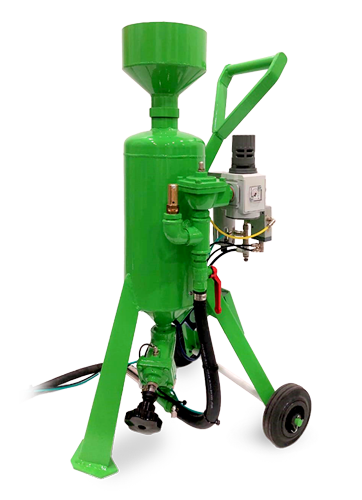
A pressure blasting machine uses a pressurised vessel to feed the abrasive.
This principle provides good removal capacity and allows work to be carried out on rust, oxidation, paint, coatings and other surface residues.
In an abrasive recovery system, blasting is integrated with extraction.
The machine therefore performs three functions simultaneously:
blasting + extraction + abrasive separation.
Correct system efficiency depends on the balance between:
- blasting pressure;
- nozzle diameter;
- compressed-air flow;
- abrasive quantity and particle size;
- extraction capacity;
- contact between the head and the surface;
- condition of the filters and brushes.
Abrasive recovery blasting machines and vacuum blasting machines
The terms abrasive recovery blasting machine and vacuum blasting machine are often used to describe similar systems.
The term “vacuum” focuses on the machine's ability to extract abrasive and dust during treatment.
The term “recovery” instead emphasises the possibility of recovering the abrasive used and, where its condition allows, reusing it.
In FEVI systems, the two functions work together: extraction recovers the material and the separation system manages the abrasive and dust.
24-litre pressure abrasive recovery blasting machines
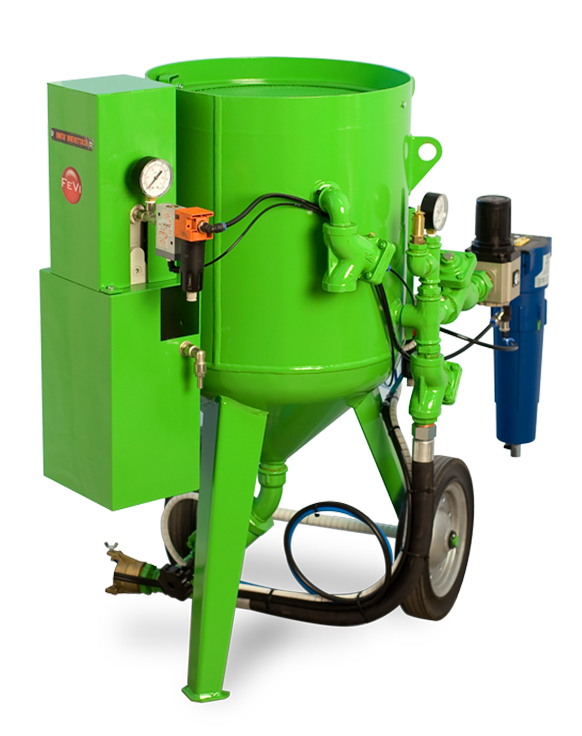
PRESSURE BASE, MAX, INFINITY and BAG use a professional system based on a 24-litre pressure blasting machine combined with different extraction and dust-management solutions.
The configuration can include:
- aluminium recovery head with brush;
- 24-litre pressure vessel;
- trolley for handling;
- cyclone for separating abrasive from dust;
- pneumatic remote control;
- extraction system;
- nozzles of different diameters according to the configuration;
- abrasive hose;
- extraction hose;
- dust-collection system.
The actual configuration depends on the model selected.
What are the advantages of an abrasive recovery blasting machine?
Reduced abrasive dispersion
The extraction head allows a substantial proportion of the material to be recovered directly from the working area, significantly reducing dispersion compared with open blasting.
Abrasive recovery
Where the abrasive and application allow it, the recovered material can be separated from the dust and reused. This can improve abrasive management during operations.
Reduced subsequent collection work
Recovering the material during treatment reduces the amount of abrasive that must be collected after the operation.
Localised operations
The recovery head makes it possible to concentrate the treatment on specific areas of the surface.
Possibility of working in controlled environments
Workshops, industrial departments, laboratories and certain worksites can benefit from technology that provides greater control of abrasive and dust dispersion.
Pressure control
The ability to adjust pressure allows the treatment to be adapted to the characteristics of the surface and the required result.
Does “dust-free” mean a total absence of dust?
No.
An abrasive recovery blasting machine is designed to substantially reduce the dispersion of abrasive and dust, but its effectiveness depends on the operating conditions.
Flat, regular surfaces allow the head to operate under the most favourable conditions.
Corners, edges, profiles, complex welds and irregular surfaces can instead make it more difficult to maintain effective contact between the brush and the surface.
It is therefore more accurate to describe the process as abrasive recovery blasting with dust extraction at source rather than as a process with an absolute absence of dust.
Where to use an abrasive recovery blasting machine
Iron and fabricated metalwork
Abrasive recovery blasting machines can be used for localised operations on:
- metal structures;
- fabricated metalwork;
- sheet metal;
- tanks;
- components;
- surfaces affected by rust or old coatings.
The technology is particularly useful where it is not practical to transfer the component into a blasting cabinet.
Welds and stainless steel
Localised treatment can be used on weld seams and defined areas by selecting appropriate abrasives and operating parameters. The process should be assessed according to the material and required finish.
Marble, granite and stone
The stone sector is one of the traditional applications for abrasive recovery systems. Headstones, slabs and marble and granite surfaces provide favourable conditions for the use of the vacuum head, particularly for localised treatment and engraving.
Glass and crystal
Using suitable stencils and configurations, it is possible to produce decorations, frosting and localised treatments.
Wood
Recovery systems can also be used on certain wooden surfaces, provided that pressure and abrasive are correctly selected according to the sensitivity of the material.
Construction
Stairs, floors, stone elements, metal structures and other surfaces can be treated where the geometry allows the recovery head to maintain proper contact.
When is an abrasive recovery blasting machine particularly suitable?
This technology should be considered particularly when:
- the operation concerns a defined area;
- abrasive recovery is important;
- dispersion into the surrounding environment needs to be limited;
- the component cannot be moved;
- the surface allows the head to operate in contact;
- work is carried out inside workshops or production departments;
- subsequent abrasive collection would represent a significant operating cost.
When open blasting may be more suitable
An abrasive recovery blasting machine does not completely replace open blasting. An open blasting machine may be preferable when:
- the surface is very large;
- there are numerous corners and irregular geometries;
- the head cannot be kept in contact with the surface;
- greater freedom of movement is required;
- productivity on large surfaces is a priority;
- abrasive dispersion can be managed by other means.
The choice should therefore be based on the application rather than simply considering one technology better than another.
FEVI abrasive recovery blasting-machine range
FEVI offers different configurations to adapt operating autonomy, portability, extraction and dust management to the working conditions.
PRESSURE BASE
PRESSURE BASE is the FEVI professional abrasive recovery system for localised operations. It integrates a 24-litre pressure blasting machine, brush head and extraction unit and is suitable for workshops, worksites, industry, maintenance and the stone sector. Learn more about the FEVI PRESSURE BASE.
PRESSURE MAX
PRESSURE MAX combines the abrasive recovery blasting system with a single-phase extraction unit featuring three cartridge filters and a cyclic filter-cleaning system. It is suitable where extraction continuity and filtration capacity are particularly important. More details about the FEVI PRESSURE MAX.
PRESSURE INFINITY
PRESSURE INFINITY uses an industrial vacuum unit with an automatic filter-cartridge cleaning system. The configuration is designed for applications where maintaining effective extraction during professional and repeated operations is particularly important. Discover the FEVI PRESSURE INFINITY.
PRESSURE BAG
PRESSURE BAG integrates a continuous-bag dust-collection system. This configuration was developed to improve management of the collected material and reduce operator contact with dust during collection and handling. View the specifications of the FEVI PRESSURE BAG.
PRESSURE TOP
PRESSURE TOP is the FEVI configuration intended for professional and industrial operations requiring greater operating autonomy. It integrates a 60-litre pressure vessel and a self-cleaning turbine industrial vacuum unit, making it suitable for longer working cycles and demanding applications. Visit the FEVI PRESSURE TOP page.
SABIX R
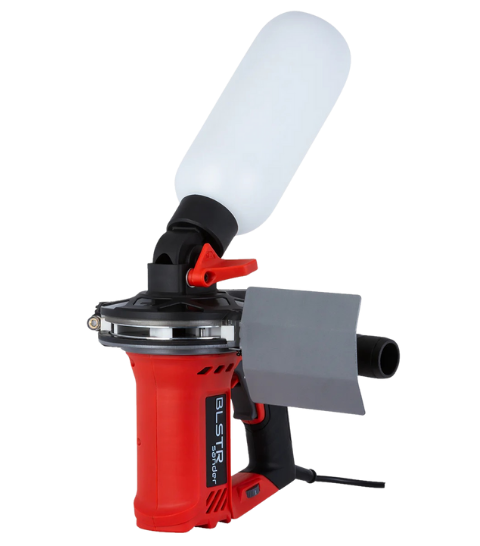
SABIX R is the FEVI portable abrasive recovery system intended particularly for small-scale operations and work carried out directly on site. The machine can also be converted for open blasting, extending its operating flexibility. Explore the FEVI SABIX R.
Which abrasive recovery blasting machine should you choose?
| Requirement | Model to consider |
|---|---|
| Small-scale operations and maximum portability | SABIX R |
| Standard professional operations | PRESSURE BASE |
| Greater extraction and filtration capacity | PRESSURE MAX |
| Automatic filter cleaning | PRESSURE INFINITY |
| Dust management with continuous bag | PRESSURE BAG |
| Greater operating autonomy and industrial use | PRESSURE TOP |
The table provides an initial guide. The final choice should take into account the surface, duration of the operation, abrasive, availability of compressed air and characteristics of the dust generated.
How to choose between PRESSURE BASE and PRESSURE MAX
PRESSURE BASE is the reference configuration for many professional abrasive recovery applications.
PRESSURE MAX should be considered when the process requires an extraction unit with greater filtration capacity and more structured filter cleaning.
The choice should therefore not be based solely on dimensions or price, but on operating frequency and extraction conditions.
When to choose PRESSURE INFINITY
PRESSURE INFINITY is particularly interesting where maintaining filtration-system efficiency during prolonged operations is especially important.
Automatic cartridge cleaning helps maintain more consistent extraction-unit performance when the process generates significant quantities of dust.
When to choose PRESSURE BAG
PRESSURE BAG should be considered where management of collected material is an important part of the application.
The continuous-bag system allows dust to be collected progressively while limiting handling of a conventional collection container.
When to choose PRESSURE TOP
PRESSURE TOP is intended for operations where autonomy and continuity of work are particularly important.
The 60-litre vessel reduces refill frequency compared with 24-litre systems, while the turbine extraction unit is designed for professional and industrial use.
The role of the brush head
The brush recovery head is one of the fundamental elements of the system.
The brush helps create a confined area around the point where the abrasive strikes the surface.
Recovery efficiency therefore also depends on:
- condition of the brush;
- contact with the surface;
- surface geometry;
- angle of the head;
- capacity of the extraction unit.
Brushes are wear components and should be inspected periodically. Specific heads or accessories may be required for particular geometries.
Abrasives for abrasive recovery blasting machines
The possibility of recovering and reusing the abrasive makes it particularly important to select a material that is compatible with the system. The following should be assessed:
- hardness;
- particle size;
- resistance to fragmentation;
- quantity of dust generated;
- surface to be treated;
- required result.
During operation, the abrasive progressively degrades and generates finer particles.
The cyclone and extraction system separate reusable material from the fraction that must be removed from the working cycle.
Compressed air and nozzle diameter
Blasting-machine performance depends directly on the availability of compressed air.
Nozzle diameter significantly affects the required airflow.
A larger nozzle can increase working capacity but requires an appropriately sized compressor.
Before selecting the configuration, the following should therefore be assessed:
- actual compressor airflow;
- available pressure;
- nozzle diameter;
- hose length;
- any other pneumatic equipment connected to the same supply.
Correct matching between blasting machine, nozzle and compressor is essential to maintain operating continuity and performance.
Extraction and filtration
In abrasive recovery blasting, the extraction unit is not a secondary component. It must provide the vacuum required to recover:
- abrasive;
- dust;
- residues;
- particles generated during treatment.
Progressive filter loading can reduce extraction capacity. For this reason, the different FEVI systems use different filtration configurations and cleaning systems according to the intended level of use.
Maintenance of abrasive recovery blasting machines
To maintain consistent operation, the following should be inspected periodically:
- nozzle;
- abrasive hose;
- extraction hose;
- recovery head;
- brush;
- cyclone;
- filters;
- filter-cleaning system;
- valves;
- fittings;
- metering system;
- dust collection container.
Particular attention should be paid to wear of the nozzle and brush because both can progressively alter system performance.
Operating recommendations
Before starting an operation:
- check the surface material;
- identify what needs to be removed;
- select the abrasive and particle size;
- verify the available compressed air;
- inspect the nozzle and brush head;
- initially set a pressure appropriate for the substrate;
- carry out a test on a limited area;
- check extraction effectiveness;
- monitor filters and components during prolonged operations.
Frequently asked questions about abrasive recovery blasting machines
How does an abrasive recovery blasting machine work?
Discover the answer
The abrasive is projected onto the surface using compressed air. A vacuum head maintained in contact with the surface simultaneously recovers abrasive, dust and residues. A separation system distinguishes material that is still suitable for use from the finer dust fraction.
What is the difference between an abrasive recovery blasting machine and an open blasting machine?
Discover the answer
In open blasting, abrasive is projected without being recovered directly by the gun. In an abrasive recovery system, the head integrates extraction and provides greater control of material dispersion.
Does an abrasive recovery blasting machine produce no dust?
Discover the answer
The process still generates dust. The system is designed to extract it directly from the working area and substantially reduce its dispersion.
Can the abrasive be reused?
Discover the answer
Yes, where its characteristics remain suitable and the type of contamination removed allows reuse. The system separates the abrasive from the finer fractions.
Which surfaces can it be used on?
Discover the answer
Metal, marble, granite, stone, glass, wood and other compatible surfaces. The head works most effectively when it can maintain proper contact with the area being treated.
Is it suitable for very irregular surfaces?
Discover the answer
Highly complex geometries can reduce recovery efficiency. In these cases, specific accessories may be required or open blasting may need to be considered.
Which compressor is required?
Discover the answer
It depends on nozzle diameter and operating pressure. The actual compressor airflow is the main parameter that should be checked.
Which model should be chosen for small-scale operations?
Discover the answer
SABIX R is the model most focused on portability and smaller operations. For more structured professional work, the different Pressure configurations can be considered.
Which model provides greater operating autonomy?
Discover the answer
PRESSURE TOP uses a 60-litre vessel and is intended for applications requiring longer working cycles.
FEVI abrasive recovery blasting machines: choose the system according to the application
FEVI abrasive recovery blasting machines combine blasting, extraction and abrasive management within a single system.
The correct choice should start from:
surface → material to be removed → size of the operation → geometry → abrasive → compressed air → extraction → required operating autonomy.
SABIX R, PRESSURE BASE, MAX, INFINITY, BAG and TOP meet different requirements in terms of portability, operating autonomy and dust management.
To compare the FEVI models directly, visit the page dedicated to FEVI abrasive recovery blasting machines.