 , Sandblasting machines with cabin


The project requirement
Explanation: In some industrial applications, a single type of abrasive is not necessarily sufficient for all the processes required.
Different components, different materials or different surface results may require abrasives with different characteristics.
The requirement may therefore be to have two separate abrasive materials available on the same machine, avoiding the need to completely reconfigure the system every time the process changes.
At the same time, the component may have a weight or dimensions that make completely manual handling impractical.
Two parallel requirements therefore arise:
correctly managing different abrasives and moving the component towards the cabinet in a controlled manner.
The technical response: a configuration such as the one developed by FEVI is created by integrating these two requirements.
Application analysis
The design must consider the component and the abrasives separately, and then establish the relationship between them.
For the component, the following must be assessed:
- Dimensions;
- Weight;
- Geometry;
- Centre of gravity;
- Loading method;
- Working position;
- Surfaces to be treated;
- Handling before and after the cycle.
For the abrasives, the following must instead be considered:
- Type;
- Particle size;
- Density;
- Behaviour during the process;
- Required surface result;
- Feed system;
- Recovery;
- Any requirement to keep the different types separate.
The presence of two abrasive vessels makes it possible to configure the system for two different abrasives, but the selection, changeover and recovery logic must be specifically defined according to the required process.
The objective is not simply to increase the amount of abrasive available, but to provide greater flexibility in selecting the material used during treatment.
The solution designed by FEVI
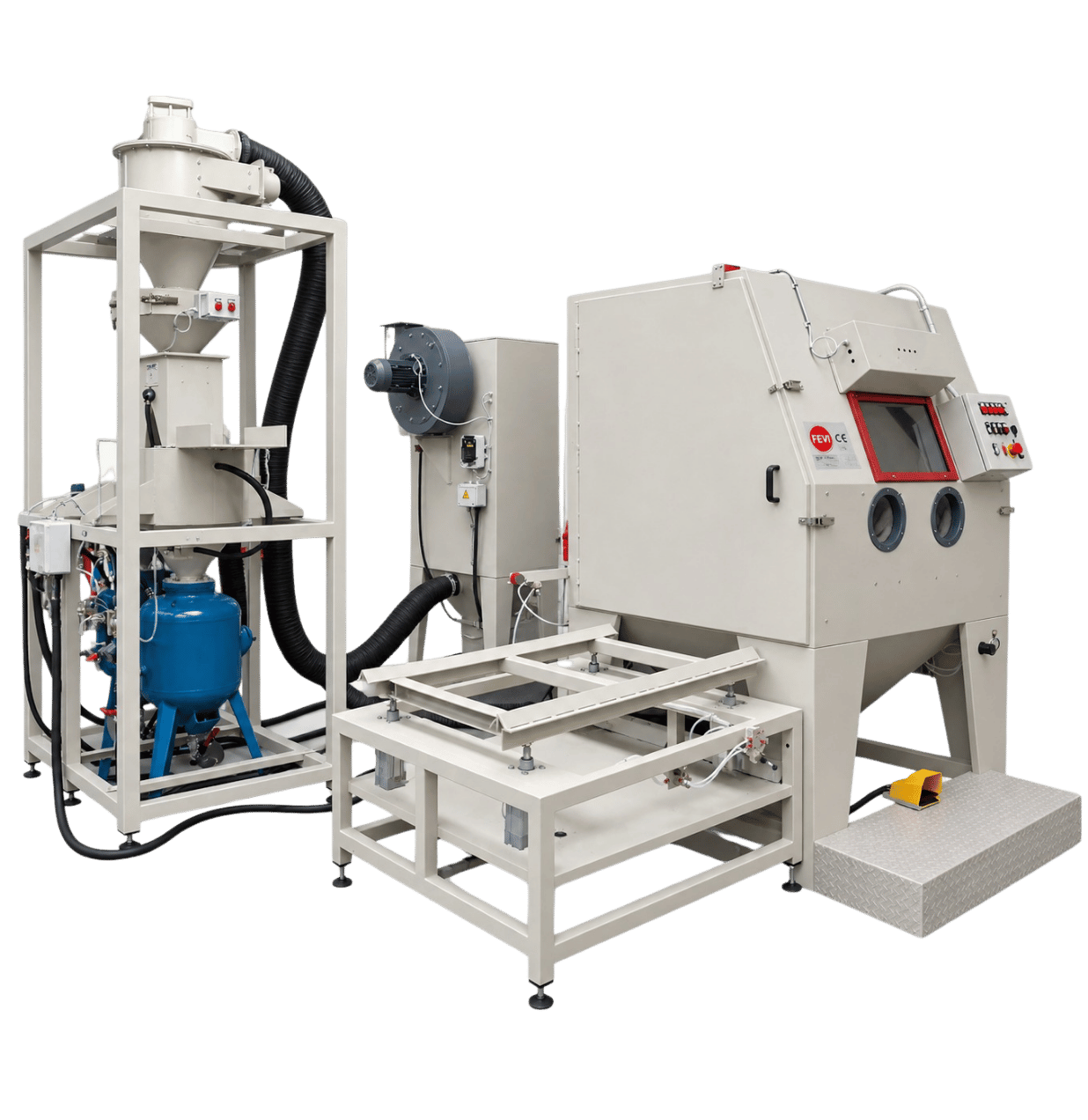
The FEVI system combines an industrial blasting cabinet with a separate unit dedicated to abrasive feeding and management.
The configuration includes:
- Treatment cabinet;
- Operator station;
- Viewing window;
- Two glove ports;
- Dedicated control panel;
- Extraction system;
- Recovery unit;
- Two abrasive vessels;
- Connection pipework;
- Pneumatic circuit;
- External handling structure;
- Dedicated rails;
- Automatic lifting system.
The component can be positioned on the external structure and then moved towards the treatment area.
The rail system defines a precise travel path, while the automatic lifting system makes it possible to manage the position of the structure according to the different stages of the cycle.
The machine therefore integrates three fundamental functions: treatment, dual-abrasive management and component handling.
How the system works
The component is initially positioned in the external loading area.
The rail system guides its transfer towards the cabinet along the path defined for the machine.
Automatic lifting makes it possible to control the position of the mobile structure during the different loading, transfer and working-area preparation stages.
Once the component has been positioned, the cabinet is prepared for treatment.
The operator works from the front station using the viewing window and glove ports.
Depending on the required process, the abrasive associated with the relevant vessel can be used.
The general process logic can therefore be represented as:
Loading → Rail-guided handling → Positioning → Abrasive-process selection → Abrasive blasting or shot blasting → Completion → External handling → Unloading.
The exact sequence for vessel selection and abrasive management depends on the specific technical configuration of the system.
Why use two different abrasives?
Each abrasive interacts with the surface differently.
Particle size, particle shape, hardness, density and material determine the behaviour of the jet and the result achieved.
Having two different abrasives available on the same machine can be useful when managing, for example:
- Components manufactured from different materials;
- Different levels of treatment aggressiveness;
- Different surface-preparation requirements;
- More intensive treatments and more controlled treatments;
- Different finishes;
- Different particle sizes;
- Production processes alternating between different applications.
Selection must always start from the surface and the required result.
The second vessel therefore does not simply provide additional storage capacity: it makes it possible to configure the machine for different treatment strategies.
Keeping the two abrasive processes separate
When two different materials are used, one of the most important design considerations is how they are managed.
Mixing abrasives with different characteristics can alter process behaviour.
For this reason, in a configuration designed for dual abrasive, the following must be analysed:
- Vessels;
- Feed lines;
- Selection systems;
- Recovery;
- Any recirculation;
- Abrasive changeover method;
- Residual contamination between the two materials.
The level of separation required depends on the application.
In some processes, simplified management may be sufficient, while in others the risk of contamination between the two abrasives must be carefully controlled.
This aspect is also defined during machine design.
The advantages of external rails
When the component is heavy or bulky, carrying out all loading operations directly inside the cabinet can be impractical.
External rails instead create a defined handling path.
The component can be positioned in a more accessible area and then transferred towards the machine.
The system also guides movement along a precise path, reducing the need to manually realign the support relative to the cabinet.
This solution can be particularly useful where the weight of the component requires a robust structure specifically designed for handling.
Why integrate automatic lifting?
Longitudinal movement is only one part of the handling requirement.
In certain configurations, it may also be necessary to change the vertical position of the external structure.
Automatic lifting makes it possible to integrate this movement into the machine cycle.
The function can be used to coordinate the different conditions required for:
- Loading;
- Transfer;
- Alignment;
- Operating position;
- Machine opening or closing;
- Component unloading.
The actual travel and operating logic of the system are defined according to the specific application.
The main advantage is that vertical handling does not depend on manual adjustments but becomes an integrated machine function.
Component handling and cabinet sealing
One of the typical challenges of systems with trolleys or external structures is combining the passage of the handling system with correct closure of the cabinet.
The rails must allow the component to enter the required position without unnecessarily compromising separation between the working environment and the external area.
A mobile or liftable system makes it possible to design the relationship between the following elements more rationally:
rail → component position → cabinet opening → closure during treatment.
Handling therefore also becomes an integral part of cabinet design.
Two levels of customisation in the same machine
This FEVI configuration is particularly significant because it addresses two very different aspects at the same time.
The first concerns the surface-treatment process, through the availability of two different abrasives.
The second concerns component logistics, through the rails and automatic lifting system.
This demonstrates a fundamental principle of special-purpose systems: a customised machine does not necessarily have to solve a single problem, but can be designed by integrating several requirements from the same production cycle.
- Configured for two different types of abrasive;
- Two dedicated abrasive vessels;
- Greater flexibility in surface treatment;
- Possibility of configuring different treatment cycles;
- Component handling along a guided path;
- External structure dedicated to loading;
- Rails integrated into the design;
- Automatic lifting system;
- Reduced need for demanding manual handling;
- Possibility of handling substantial components;
- Integration between loading and the treatment area;
- Coordinated management of the component and abrasive;
- Possibility of further customising material recovery and selection.
System features
| Element | Configuration |
|---|---|
| Type | Custom industrial blasting cabinet |
| Operating mode | Manual |
| Operator station | Front |
| Visual inspection | Viewing window |
| Manual access | Two glove ports |
| Abrasive system | Dual |
| Abrasive vessels | Two |
| Abrasive types | Two different materials according to the application |
| Feed system | Integrated into the system |
| Abrasive recovery | Included |
| Extraction | Dedicated unit |
| Component handling | On rails |
| External rails | Included |
| Loading structure | Dedicated |
| Lifting | Automatic |
| Machine controls | Dedicated control panel |
| Foot control | Included |
| Vessel capacity | Data not available |
| Abrasive selection system | To be verified according to the technical configuration |
| Separate recovery management | To be defined according to the application |
| Mobile-structure load capacity | Data not available |
| Lifting travel | Data not available |
| Useful cabinet dimensions | Data not available |
| Abrasives used | To be defined according to the application |
| Process | Abrasive blasting or shot blasting depending on the configuration |
Possible applications
A dual-abrasive blasting cabinet can be considered where the process requires different treatment conditions on the same machine.
Possible applications include:
- Mechanical components;
- Castings;
- Moulds;
- Fabricated metalwork;
- Welded structures;
- Pump bodies;
- Valve bodies;
- Large metal components;
- Components manufactured from different materials;
- Production requiring different levels of surface preparation;
- Components requiring abrasives with different levels of aggressiveness;
- Processes requiring different finishes;
- Heavy components requiring a dedicated handling system.
The combination of the two abrasives must be assessed according to the actual production cycle.
One system for different surface requirements
In certain production processes, different components may need to be treated to achieve different results.
The simplest solution is not necessarily to install two separate machines.
Where the process and material-management requirements allow it, a blasting cabinet configured for two different abrasives can be developed.
This approach can help concentrate different operations within the same system while retaining the ability to adapt the treatment to the component.
However, this principle must be engineered correctly: simply adding a second vessel is not enough. The complete path of the abrasive through the machine must be analysed.
A machine designed around the component and the abrasive
In many FEVI case histories, the component is the starting point for the design.
In this machine, a second and equally important variable comes into play: the abrasive.
The project must simultaneously answer questions such as:
Which component has to be treated? How much does it weigh? How must it be handled? What surface result is required? Is one abrasive sufficient? Must the materials remain separate? How should they be recovered?
From this information, the following can be defined:
- Abrasive vessels;
- Abrasive circuits;
- Selection methods;
- Recovery;
- Handling system;
- Rails;
- Lifting system;
- Cabinet dimensions;
- Operator station.
FEVI can therefore develop the system around the relationship between the component, abrasive and production process.
Custom system or standard blasting cabinet?
Not every application requires two abrasives or automatic handling systems.
For conventional processes using a single type of abrasive and easily handled components, a standard blasting cabinet may be the simplest and most rational solution.
Where process requirements become more complex, FEVI can instead consider:
- Standard blasting cabinets;
- Cabinets with abrasive recovery;
- Cabinets with trolleys;
- Rail-mounted systems;
- Rotary tables;
- Lifting systems;
- Dual-abrasive cabinets;
- Shot blasting cabinets;
- Systems with abrasive selection;
- Semi-automatic systems;
- Automatic systems;
- Fully customised machines.
The level of complexity is defined according to the actual production requirement.
Frequently asked questions – Blasting cabinet with dual abrasive and rails
What is the purpose of a blasting cabinet with two abrasive vessels?
It makes it possible to configure the machine for two different types of abrasive, selected according to the component and the required surface result.
Can two different abrasives be used on the same blasting machine?
Yes, when the machine is specifically designed for this requirement. The vessels, feed system, selection and recovery must be assessed according to the two materials used.
Are the two abrasives mixed together?
Not necessarily. In a configuration designed for two different materials, one of the objectives may be to keep their management separate. The level of separation required, however, depends on the process and the recovery system adopted.
Why use external rails?
The rails guide the component towards the treatment area along a defined path. They are particularly useful when the component is heavy or must be handled using a dedicated support structure.
What is the purpose of the automatic rail lifting system?
It automatically changes the vertical position of the external system during the different stages of the cycle according to loading, alignment and cabinet configuration.
Can the system be sized for heavy components?
In a customised system, the structure, rails and lifting system must be sized according to the actual weight and geometry of the component.
Does FEVI also manufacture cabinets using a single abrasive?
Yes. When the process does not require two different materials to be managed, FEVI can provide standard or customised cabinets with a single abrasive system and a level of component handling suited to the application.
Do you need to use different abrasives or handle components that are difficult to move?
When a process requires multiple abrasives, heavy components or specific loading systems, the machine must be designed around the complete cycle rather than the blasting chamber alone.
FEVI can analyse the component, abrasives, handling requirements and required surface result to develop the most appropriate configuration: from a conventional cabinet to a customised system with dual abrasive, rails and automatic handling systems.
TELL US ABOUT YOUR PROJECT
For an initial assessment, you can provide:
- Photographs of the component;
- Material;
- Dimensions;
- Weight;
- Quantity to be treated;
- First type of abrasive;
- Second type of abrasive;
- Particle sizes;
- Reason for using the two materials;
- Component handling method;
- Required surface result;
- Required productivity.
Together we analyse the component, its movement and the abrasive: the machine is designed around the complete process.