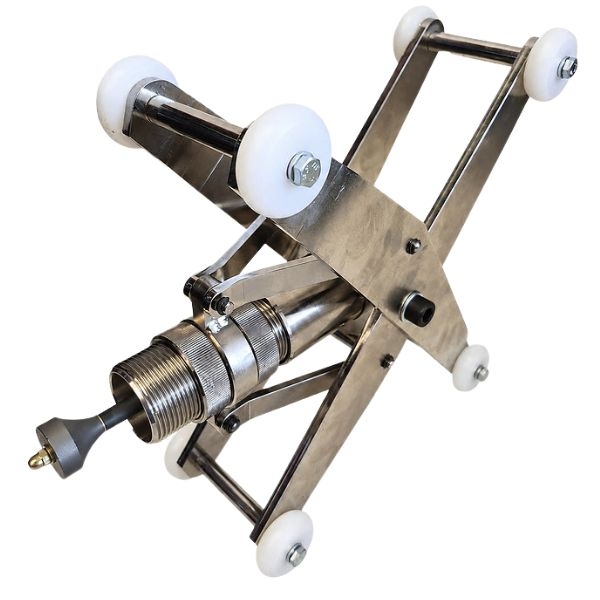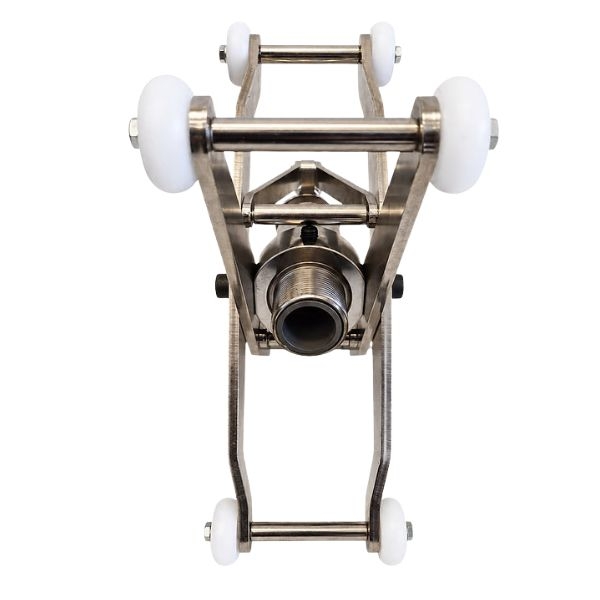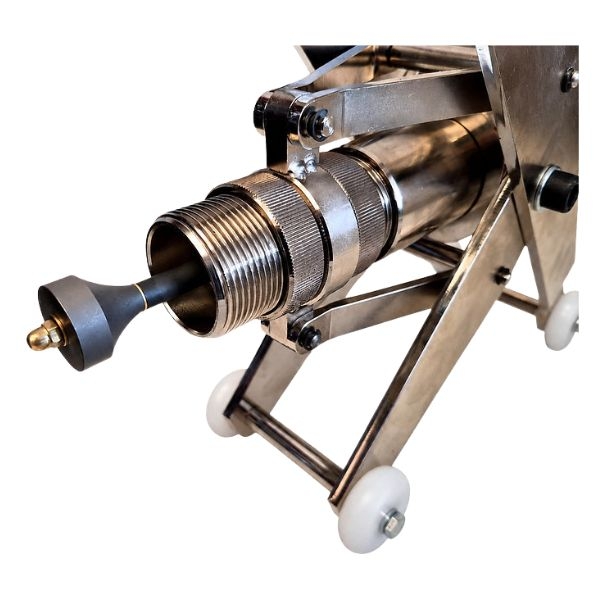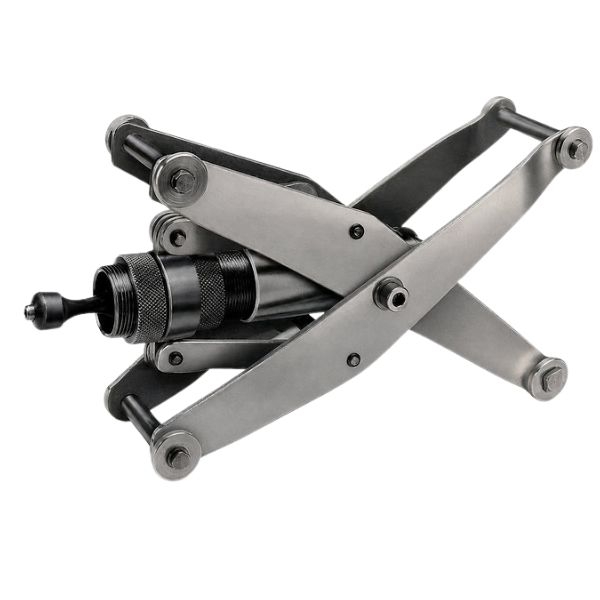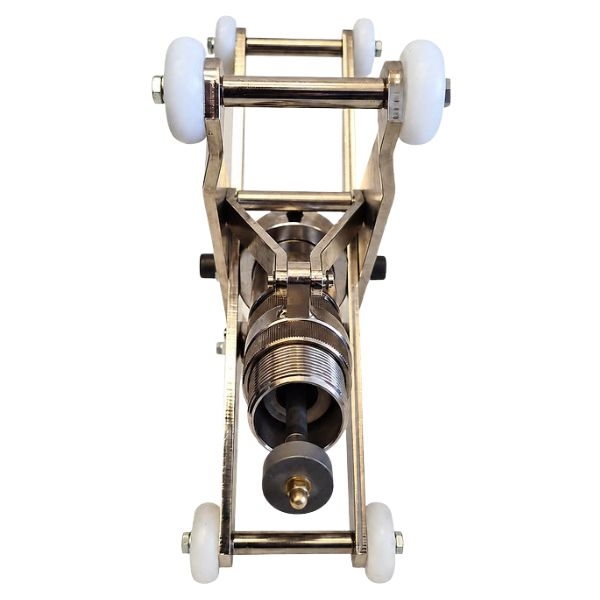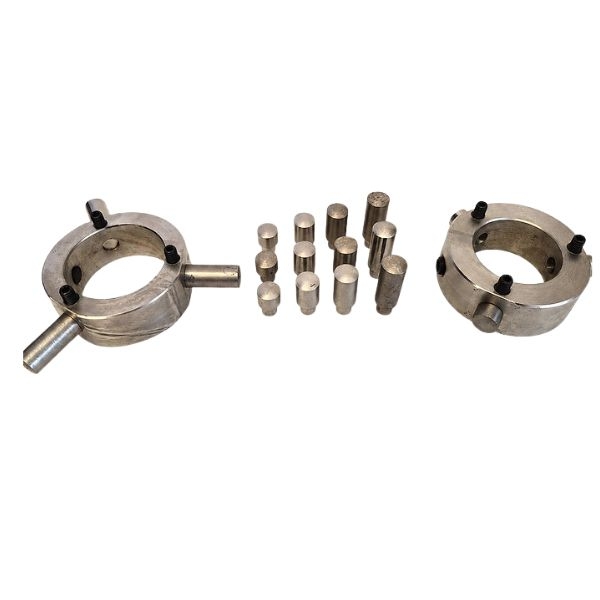
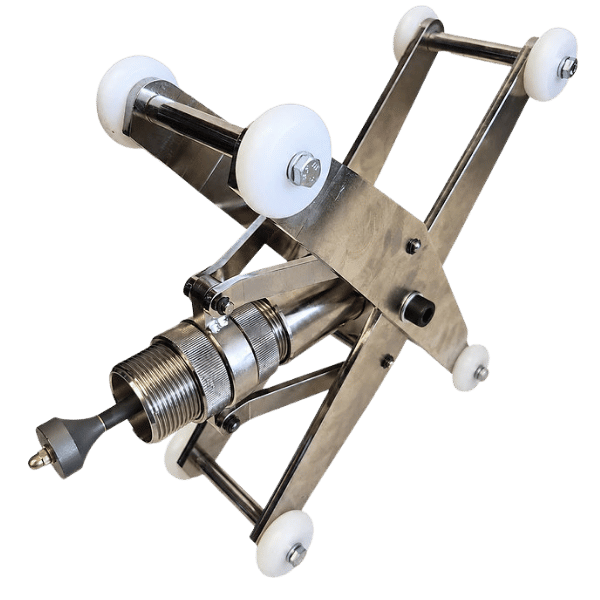


The adjustable centring carriage, included in the configuration, keeps the accessory aligned with the pipe axis and provides greater stability while moving along the pipe. This makes it possible to remove rust, oxidation, mill scale, residues and old coatings, preparing the internal walls for painting or anti-corrosion protection.
Main benefits
360° radial coverage
The jet reaches the entire internal circumference simultaneously.
Adjustable centring carriage
Maintains a more consistent distance between the deflection cone and the pipe wall.
Diameters from 130 to 300 mm
A dedicated configuration for medium-diameter pipes.
Stable movement
The wheels facilitate controlled forward or return movement along straight pipe sections.
No pipe rotation required
The circular jet treats the entire perimeter without requiring the pipe to be rotated during the pass.
Preparation for coatings
Helps achieve a more uniform internal surface before applying protective coating systems.
AT A GLANCE Internal diameters 130–300 mm | 360° radial jet | Inverted-cone nozzle | Adjustable centring carriage included | Connection to a professional pressure blasting machine.
What is HOLLOBLAST MAX?
HOLLOBLAST MAX is an accessory designed to be connected to a professional pressure blasting machine in place of the standard working nozzle. Its purpose is to transform the axial jet into a circular distribution suitable for the internal surfaces of pipes.
The inverted cone intercepts the air-abrasive mixture and deflects it radially towards the wall. The adjustable carriage supports the accessory body and keeps it centred. By moving the system along the pipe at a controlled speed, the entire accessible internal surface is progressively treated without having to rotate the pipe or manually direct the jet.
Why centring is essential
In an internal blasting system, even a 360° jet can produce uneven results if the nozzle operates very close to one wall and far from the opposite wall. The centring carriage reduces this misalignment and helps maintain a more consistent distance around the circumference.
Correct centring promotes more uniform treatment, improves repeatability and makes the relationship between travel speed and removal level more predictable. Before use, the carriage must be adjusted to the actual internal diameter of the pipe and its movement checked with the system switched off.
How the inverted-cone jet works
- Connection to the blasting machine: HOLLOBLAST MAX is installed on the abrasive line of a professional pressure blasting machine.
- Mixture inlet: compressed air and abrasive reach the internal nozzle.
- 360° deflection: the inverted cone distributes the jet radially against the pipe wall.
- Carriage adjustment: the wheels are positioned to keep the system centred within the diameter being treated.
- Longitudinal movement: the accessory is moved forwards or pulled back through the pipe at a controlled speed.
- Result inspection: uniformity, removal grade and surface profile are checked before the protective coating cycle.
What it can remove from internal walls
HOLLOBLAST MAX is suitable for removing rust, oxidation, mill scale, processing residues and adhering old coatings. Productivity and preparation grade depend on the initial conditions, abrasive type, actual nozzle pressure, airflow and travel speed.
When the pipe is to receive a new coating, the process can create the required surface profile for adhesion. Compliance with the protective coating specification must be verified on the component, because HOLLOBLAST MAX is the application tool and does not replace inspection of the preparation grade or surface roughness.
Operating benefits of HOLLOBLAST MAX
Circular treatment without rotating the pipe
The 360° jet reaches the entire internal perimeter during longitudinal movement. This simplifies the process, particularly when pipes are heavy, long or difficult to handle.
Greater stability along the pipe
The centring carriage supports the accessory and guides its movement. A more stable position reduces jet variations caused by oscillation or irregular contact with the pipe wall.
Adjustable exposure time
The forward or return speed can be adapted to the condition of the pipe. Areas with mill scale or more resistant coatings generally require longer exposure than surfaces with light oxidation.
More uniform preparation for anti-corrosion protection
A consistently treated internal surface facilitates the application of primers and subsequent coatings. This benefit is particularly relevant when pipes are intended for industrial environments or conditions requiring controlled anti-corrosion protection.
Recommended applications
- Internal preparation of metal pipes before painting, coating or anti-corrosion protection.
- Removal of mill scale and oxidation from new or stored pipes before commissioning.
- Maintenance and reconditioning of pipes and straight cylindrical components.
- Operations for metal-fabrication companies, workshops, plant manufacturers and companies in the metalworking sector.
- Treatment of pipe sections intended for industrial plants, energy, infrastructure and marine applications, after verification of the process and any residues present.
How to configure the system correctly
- Actual internal diameter: measure the pipe at several points and check for ovality, welds, deposits and restrictions.
- Carriage: adjust the wheels to achieve stable centring without obstructing movement.
- Compressed air: size the compressor, hoses and fittings according to the nozzle diameter and the pressure required at the working point.
- Abrasive: select the material and particle size according to the substrate, contamination and required final profile.
- Movement: define a consistent forward or return system; for repetitive work, controlled speed improves repeatability.
- Preliminary test: validate the parameters on a sample section before production or full treatment.
Travel speed determines the result
360° distribution does not automatically guarantee the required preparation grade. The jet exposure time on each section depends on the speed at which HOLLOBLAST MAX travels through the pipe. Moving too quickly can leave residues, while moving too slowly can increase abrasive consumption, roughness and wear.
For repetitive operations, it is useful to define a consistent pulling method and record the effective parameters: pressure, abrasive, speed, number of passes and measured result. This makes internal pipe blasting a more controllable and repeatable process.
Compatibility, limitations and safety
HOLLOBLAST MAX is designed for pipes with internal diameters from 130 to 300 mm and primarily for straight sections. Bends, elbows, internal flanges, protruding weld beads, changes in cross-section or obstructions may prevent the carriage from passing and require a technical assessment.
The system does not automatically include abrasive extraction or recovery. The ends of the pipe must therefore be managed in an area suitable for blasting, with containment of abrasive and dust, suitable operator protection and procedures consistent with the risk assessment.
Before treating previously used pipes, make sure they are isolated, depressurised and free from flammable, explosive, toxic or reactive substances. Do not begin the operation if the pipe's previous use or internal residues are unknown and cannot be safely managed.
Frequently asked questions about HOLLOBLAST MAX
1. Which pipe diameters is HOLLOBLAST MAX designed for?
View answer
It is designed for pipes with internal diameters from 130 to 300 mm. The measurement must refer to the actual internal clearance, taking into account deposits, welds, tolerances and possible ovality.
2. What is the centring carriage used for?
View answer
The adjustable carriage keeps the accessory close to the pipe axis and stabilises its movement. This helps maintain a more consistent distance between the inverted cone and the pipe wall around the circumference.
3. Does the pipe need to be rotated during blasting?
View answer
No. The jet is distributed radially through 360°, so the entire circumference is treated during longitudinal movement without rotating the pipe.
4. Which compressor is required for HOLLOBLAST MAX?
View answer
The required airflow depends on the actual nozzle diameter, operating pressure, abrasive and line losses. FEVI sizes the compressor only after the complete configuration has been defined.
5. Which abrasive is recommended?
View answer
This depends on the metal, the material to be removed and the required surface profile. The abrasive type and particle size must be compatible with the nozzle and inverted cone and should be verified before use.
6. Can it remove mill scale and existing coatings?
View answer
Yes. HOLLOBLAST MAX can remove rust, oxidation, mill scale, residues and old coatings. The number of passes and travel speed vary according to coating thickness and adhesion.
7. Is it suitable for curved pipes or elbows?
View answer
It is primarily intended for straight pipes. Bends, elbows, restrictions and internal obstructions may prevent the carriage from passing and require a different configuration or a specific assessment.
8. Is internal blasting automatically uniform?
View answer
The 360° jet and centring system promote uniformity, but the result also depends on pressure, abrasive, wear condition, travel speed and the initial condition of the pipe. A preliminary test is recommended.
9. Does HOLLOBLAST MAX recover abrasive and dust?
View answer
No. The system distributes the blasting jet but does not integrate abrasive recovery. Containment, extraction and collection must be provided in the working area or as part of the system configuration.
10. Which model should I choose: MINI or MAX?
View answer
MINI covers internal diameters from 19 to 50 mm, while MAX covers diameters from 130 to 300 mm. For different diameters or special operating conditions, contact FEVI for a dedicated technical solution.